ModuleOpticalElement
Provides the class for a general optical element, which serves to connect the “lab-frame”, in which the light rays are traced, to the proper “optic” coordinate frame in which an optic is defined. So this class is what serves to "align" the optics in lab-space, and it provides methods to modify its alignment.
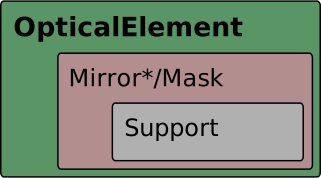
The optic can be a Mirror-object or a Mask-object.
Created in Apr 2020
@author: Anthony Guillaume + Stefan Haessler
1""" 2Provides the class for a general optical element, which serves to connect the “lab-frame”, 3in which the light rays are traced, to the proper “optic” coordinate frame in 4which an optic is defined. So this class is what serves to "align" the optics in lab-space, 5and it provides methods to modify its alignment. 6 7The optic can be a [Mirror-object](ModuleMirror.html) or a [Mask-object](ModuleMask.html). 8 9 10 11 12 13Created in Apr 2020 14 15@author: Anthony Guillaume + Stefan Haessler 16""" 17# %% 18import ARTcore.ModuleGeometry as mgeo 19from ARTcore.ModuleGeometry import Origin 20 21import numpy as np 22from abc import ABC, abstractmethod 23import logging 24 25logger = logging.getLogger(__name__) 26 27 28# %% 29class OpticalElement(ABC): 30 """ 31 An optical element, can be either a Mirror or a Mask. In the future, one could add Gratings, DispersiveMedium etc... 32 33 Attributes: TODO update 34 ---------- 35 position : np.ndarray 36 Coordinate vector of the optical element’s center point in the lab frame. 37 What this center is, depends on the 'type', but it is generally the center of symmetry 38 of the Support of the optic. It is marked by the point 'P' in the drawings in the 39 documentation of the Mirror-classes for example. 40 41 orientation: np.quaternion 42 Orientation of the optic in the lab reference frame. From this, we calculate 43 the normal, the majoraxis and any other interesting vectors that are of 44 interest for a specific OpticalElement subclass. 45 46 normal : np.ndarray 47 Lab-frame vector pointing against the direction that would be considered 48 as normal incidence on the optical element. 49 50 majoraxis : np.ndarray 51 Lab-frame vector of another distinguished axis of non-rotationally symmetric optics, 52 like the major axes of toroidal/elliptical mirrors or the off-axis direction of 53 off-axis parabolas. This fixes the optical element’s rotation about 'normal'. 54 It is required to be perpendicular to 'normal', and is usually the x-axis in the 55 optic's proper coordinate frame. 56 57 What this 'majoraxis' is, e.g. for the different kinds of mirrors, is illustrated 58 in the documentation of the Mirror-classes. 59 60 For pure p or s polarization, the light incidence plane should be the 61 plane spanned by 'normal' and 'majoraxis', so that the incidence angle is varied 62 by rotating the optical element around the cross product 'normal' x 'majoraxis'. 63 64 65 Methods 66 ---------- 67 rotate_pitch_by(angle) 68 69 rotate_roll_by(angle) 70 71 rotate_yaw_by(angle) 72 73 rotate_random_by(angle) 74 75 shift_along_normal(distance) 76 77 shift_along_major(distance) 78 79 shift_along_cross(distance) 80 81 shift_along_random(distance) 82 83 """ 84 # %% Starting 3d orientation definition 85 _description = "Generic Optical Element" 86 87 def __hash__(self): 88 return super().__hash__()+hash(self._r)+hash(self._q) 89 90 @property 91 def description(self): 92 """ 93 Return a description of the optical element. 94 """ 95 return self._description 96 97 @property 98 def r(self): 99 """ 100 Return the offset of the optical element from its reference frame to the lab reference frame. 101 Not that this is **NOT** the position of the optical element's center point. Rather it is the 102 offset of the reference frame of the optical element from the lab reference frame. 103 """ 104 return self._r 105 106 @r.setter 107 def r(self, NewPosition): 108 """ 109 Set the offset of the optical element from its reference frame to the lab reference frame. 110 """ 111 if isinstance(NewPosition, mgeo.Point) and len(NewPosition) == 3: 112 self._r = NewPosition 113 else: 114 raise TypeError("Position must be a 3D mgeo.Point.") 115 @property 116 def q(self): 117 """ 118 Return the orientation of the optical element. 119 The orientation is stored as a unit quaternion representing the rotation from the optic's coordinate frame to the lab frame. 120 """ 121 return self._q 122 123 @q.setter 124 def q(self, NewOrientation): 125 """ 126 Set the orientation of the optical element. 127 This function normalizes the input quaternion before storing it. 128 If the input is not a quaternion, raise a TypeError. 129 """ 130 if isinstance(NewOrientation, np.quaternion): 131 self._q = NewOrientation.normalized() 132 else: 133 raise TypeError("Orientation must be a quaternion.") 134 135 @property 136 def position(self): 137 """ 138 Return the position of the basepoint of the optical element. Often it is the same as the optical centre. 139 This position is the one around which all rotations are performed. 140 """ 141 return self.r0 + self.r 142 143 @property 144 def orientation(self): 145 """ 146 Return the orientation of the optical element. 147 The utility of this method is unclear. 148 """ 149 return self.q 150 151 @property 152 def basis(self): 153 return self.r0, self.r, self.q 154 # %% Start of other methods 155 def __init__(self): 156 self._r = mgeo.Vector([0.0, 0.0, 0.0]) 157 self._q = np.quaternion(1, 0, 0, 0) 158 self.r0 = mgeo.Point([0.0, 0.0, 0.0]) 159 160 @abstractmethod 161 def propagate_raylist(self, RayList, alignment=False): 162 """ 163 This method is used to propagate a list of rays through the optical element. Implement this method in the subclasses. 164 In the case of a mirror, the method should reflect the rays off the mirror surface. 165 In the case of a mask, the method should block the rays that hit the mask. 166 In the case of a grating, the method should diffract the rays according to the grating equation. 167 """ 168 pass 169 170 def add_global_points(self, *args): 171 """ 172 Automatically add global properties for point attributes. 173 As arguments it takes the names of the global point attributes and seeks for the corresponding local point attributes. 174 Then it creates a property for the global point attribute. 175 176 Example: 177 Suppose the optical element has an attribute 'center_ref' that is the center of the optical element in the optic's coordinate frame. 178 Then, calling object.add_global_points('center') will create a property 'center' that returns the global position of the center of the optical element. 179 It takes into account the position and orientation of the optical element. 180 """ 181 for arg in args: 182 local_attr = f"{arg}_ref" 183 if hasattr(self, local_attr): 184 # Dynamically define a property for the global point 185 setattr(self.__class__, arg, property(self._create_global_point_property(local_attr))) 186 187 def add_global_vectors(self, *args): 188 """ 189 Automatically add global properties for vector attributes. 190 As arguments it takes the names of the global vector attributes and seeks for the corresponding local vector attributes. 191 Then it creates a property for the global vector attribute. 192 193 Example: 194 Suppose the optical element has an attribute 'normal_ref' that is the normal of the optical element in the optic's coordinate frame. 195 Then, calling object.add_global_vectors('normal') will create a property 'normal' that returns the global normal of the optical element. 196 """ 197 for arg in args: 198 local_attr = f"{arg}_ref" 199 if hasattr(self, local_attr): 200 # Dynamically define a property for the global vector 201 setattr(self.__class__, arg, property(self._create_global_vector_property(local_attr))) 202 203 def _create_global_point_property(self, local_attr): 204 """ 205 Return a function that computes the global point. 206 This is the actual function that is used to create the global point property. It performs the transformation of the local point to the global reference frame. 207 """ 208 def global_point(self): 209 # Translate the local point to the global reference frame 210 local_point = getattr(self, local_attr) 211 return local_point.from_basis(*self.basis) 212 return global_point 213 214 def _create_global_vector_property(self, local_attr): 215 """ 216 Return a function that computes the global vector. 217 This is the actual function that is used to create the global vector property. It performs the transformation of the local vector to the global reference frame. 218 """ 219 def global_vector(self): 220 # Rotate the local vector to the global reference frame 221 local_vector = getattr(self, local_attr) 222 return local_vector.from_basis(*self.basis) 223 return global_vector 224 # %% Starting 3d misalignment definitions 225 # This section needs to be reworked to be more general and to allow for more flexibility in the alignment of the optical elements. TODO 226 227 def rotate_pitch_by(self, angle): 228 """ 229 Pitch rotation, i.e. rotates the optical element about the axis ('normal' x 'majoraxis'), by the 230 given angle. 231 If the plane spanned by 'normal' and 'majoraxis' is the incidence plane (normally the case 232 in a "clean alignment" situation for pure p or s polarization), then this is simply a modificaiton 233 of the incidence angle by "angle". But in general, if the optical element has some odd orientation, 234 there is not a direct correspondence. 235 236 Parameters 237 ---------- 238 angle : float 239 Rotation angle in *degrees*. 240 """ 241 rotation_axis = np.cross(self.support_normal, self.majoraxis) 242 self.q = mgeo.QRotationAroundAxis(rotation_axis, np.deg2rad(angle))*self.q 243 244 def rotate_roll_by(self, angle): 245 """ 246 Roll rotation, i.e. rotates the optical element about its 'majoraxis' by the given angle. 247 248 Parameters 249 ---------- 250 angle : float 251 Rotation angle in *degrees*. 252 """ 253 254 self.q = mgeo.QRotationAroundAxis(self.majoraxis, np.deg2rad(angle))*self.q 255 256 def rotate_yaw_by(self, angle): 257 """ 258 Yaw rotation, i.e. rotates the optical element about its 'normal' by the given angle. 259 260 Parameters 261 ---------- 262 angle : float 263 Rotation angle in *degrees*. 264 """ 265 self.q = mgeo.QRotationAroundAxis(self.support_normal, np.deg2rad(angle))*self.q 266 267 def rotate_random_by(self, angle): 268 """ 269 Rotates the optical element about a randomly oriented axis by the given angle. 270 271 Parameters 272 ---------- 273 angle : float 274 Rotation angle in *degrees*. 275 """ 276 277 self.q = mgeo.QRotationAroundAxis(np.random.random(3), np.deg2rad(angle))*self.q 278 279 def shift_along_normal(self, distance): 280 """ 281 Shifts the optical element along its 'normal' by the given distance. 282 283 Parameters 284 ---------- 285 distance : float 286 Shift distance in mm. 287 """ 288 self.r = self.r + distance * self.support_normal 289 290 def shift_along_major(self, distance): 291 """ 292 Shifts the optical element along its 'majoraxis' by the given distance. 293 294 Parameters 295 ---------- 296 distance : float 297 Shift distance in mm. 298 """ 299 self.r = self.r + distance * self.majoraxis 300 301 def shift_along_cross(self, distance): 302 """ 303 Shifts the optical element along the axis 'normal'x'majoraxis' 304 (typically normal to the light incidence plane) by the given distance. 305 306 Parameters 307 ---------- 308 distance : float 309 Shift distance in mm. 310 """ 311 self.r = self.r + distance * mgeo.Normalize(np.cross(self.support_normal, self.majoraxis)) 312 313 def shift_along_random(self, distance): 314 """ 315 Shifts the optical element along a random direction by the given distance. 316 317 Parameters 318 ---------- 319 distance : float 320 Shift distance in mm. 321 """ 322 self.r = self.r + distance * mgeo.Normalize(np.random.random(3))
 30class OpticalElement(ABC):
 31    """
 32    An optical element, can be either a Mirror or a Mask. In the future, one could add Gratings, DispersiveMedium etc...
 33
 34    Attributes: TODO update
 35    ----------
 36        position : np.ndarray
 37            Coordinate vector of the optical element’s center point in the lab frame.
 38            What this center is, depends on the 'type', but it is generally the center of symmetry
 39            of the Support of the optic. It is marked by the point 'P' in the drawings in the
 40            documentation of the Mirror-classes for example.
 41
 42        orientation: np.quaternion
 43            Orientation of the optic in the lab reference frame. From this, we calculate
 44            the normal, the majoraxis and any other interesting vectors that are of
 45            interest for a specific OpticalElement subclass.
 46
 47        normal : np.ndarray
 48            Lab-frame vector pointing against the direction that would be considered
 49            as normal incidence on the optical element.
 50
 51        majoraxis : np.ndarray
 52            Lab-frame vector of another distinguished axis of non-rotationally symmetric optics,
 53            like the major axes of toroidal/elliptical mirrors or the off-axis direction of
 54            off-axis parabolas. This fixes the optical element’s rotation about 'normal'.
 55            It is required to be perpendicular to 'normal', and is usually the x-axis in the
 56            optic's proper coordinate frame.
 57
 58            What this 'majoraxis' is, e.g. for the different kinds of mirrors, is illustrated
 59            in the documentation of the Mirror-classes.
 60
 61            For pure p or s polarization, the light incidence plane should be the
 62            plane spanned by 'normal' and 'majoraxis', so that the incidence angle is varied
 63            by rotating the optical element around the cross product 'normal' x 'majoraxis'.
 64
 65
 66    Methods
 67    ----------
 68        rotate_pitch_by(angle)
 69
 70        rotate_roll_by(angle)
 71
 72        rotate_yaw_by(angle)
 73
 74        rotate_random_by(angle)
 75
 76        shift_along_normal(distance)
 77
 78        shift_along_major(distance)
 79
 80        shift_along_cross(distance)
 81
 82        shift_along_random(distance)
 83
 84    """
 85    # %% Starting 3d orientation definition
 86    _description = "Generic Optical Element"
 87
 88    def __hash__(self):
 89        return super().__hash__()+hash(self._r)+hash(self._q)
 90
 91    @property
 92    def description(self):
 93        """
 94        Return a description of the optical element.
 95        """
 96        return self._description
 97
 98    @property
 99    def r(self):
100        """
101        Return the offset of the optical element from its reference frame to the lab reference frame.
102        Not that this is **NOT** the position of the optical element's center point. Rather it is the
103        offset of the reference frame of the optical element from the lab reference frame.
104        """
105        return self._r
106
107    @r.setter
108    def r(self, NewPosition):
109        """
110        Set the offset of the optical element from its reference frame to the lab reference frame.
111        """
112        if isinstance(NewPosition, mgeo.Point) and len(NewPosition) == 3:
113            self._r = NewPosition
114        else:
115            raise TypeError("Position must be a 3D mgeo.Point.")
116    @property
117    def q(self):
118        """
119        Return the orientation of the optical element.
120        The orientation is stored as a unit quaternion representing the rotation from the optic's coordinate frame to the lab frame.
121        """
122        return self._q
123
124    @q.setter
125    def q(self, NewOrientation):
126        """
127        Set the orientation of the optical element.
128        This function normalizes the input quaternion before storing it.
129        If the input is not a quaternion, raise a TypeError.
130        """
131        if isinstance(NewOrientation, np.quaternion):
132            self._q = NewOrientation.normalized()
133        else:
134            raise TypeError("Orientation must be a quaternion.")
135
136    @property
137    def position(self):
138        """
139        Return the position of the basepoint of the optical element. Often it is the same as the optical centre.
140        This position is the one around which all rotations are performed.
141        """
142        return self.r0 + self.r
143
144    @property
145    def orientation(self):
146        """
147        Return the orientation of the optical element.
148        The utility of this method is unclear.
149        """
150        return self.q
151
152    @property
153    def basis(self):
154        return self.r0, self.r, self.q
155    # %% Start of other methods
156    def __init__(self):
157        self._r = mgeo.Vector([0.0, 0.0, 0.0])
158        self._q = np.quaternion(1, 0, 0, 0)
159        self.r0 = mgeo.Point([0.0, 0.0, 0.0])
160
161    @abstractmethod
162    def propagate_raylist(self, RayList, alignment=False):
163        """
164        This method is used to propagate a list of rays through the optical element. Implement this method in the subclasses.
165        In the case of a mirror, the method should reflect the rays off the mirror surface.
166        In the case of a mask, the method should block the rays that hit the mask.
167        In the case of a grating, the method should diffract the rays according to the grating equation.
168        """
169        pass
170
171    def add_global_points(self, *args):
172        """
173        Automatically add global properties for point attributes.
174        As arguments it takes the names of the global point attributes and seeks for the corresponding local point attributes.
175        Then it creates a property for the global point attribute.
176
177        Example:
178        Suppose the optical element has an attribute 'center_ref' that is the center of the optical element in the optic's coordinate frame.
179        Then, calling object.add_global_points('center') will create a property 'center' that returns the global position of the center of the optical element.
180        It takes into account the position and orientation of the optical element.
181        """
182        for arg in args:
183            local_attr = f"{arg}_ref"
184            if hasattr(self, local_attr):
185                # Dynamically define a property for the global point
186                setattr(self.__class__, arg, property(self._create_global_point_property(local_attr)))
187
188    def add_global_vectors(self, *args):
189        """
190        Automatically add global properties for vector attributes.
191        As arguments it takes the names of the global vector attributes and seeks for the corresponding local vector attributes.
192        Then it creates a property for the global vector attribute.
193
194        Example:
195        Suppose the optical element has an attribute 'normal_ref' that is the normal of the optical element in the optic's coordinate frame.
196        Then, calling object.add_global_vectors('normal') will create a property 'normal' that returns the global normal of the optical element.
197        """
198        for arg in args:
199            local_attr = f"{arg}_ref"
200            if hasattr(self, local_attr):
201                # Dynamically define a property for the global vector
202                setattr(self.__class__, arg, property(self._create_global_vector_property(local_attr)))
203
204    def _create_global_point_property(self, local_attr):
205        """
206        Return a function that computes the global point.
207        This is the actual function that is used to create the global point property. It performs the transformation of the local point to the global reference frame.
208        """
209        def global_point(self):
210            # Translate the local point to the global reference frame
211            local_point = getattr(self, local_attr)
212            return local_point.from_basis(*self.basis)
213        return global_point
214
215    def _create_global_vector_property(self, local_attr):
216        """
217        Return a function that computes the global vector.
218        This is the actual function that is used to create the global vector property. It performs the transformation of the local vector to the global reference frame.
219        """
220        def global_vector(self):
221            # Rotate the local vector to the global reference frame
222            local_vector = getattr(self, local_attr)
223            return local_vector.from_basis(*self.basis)
224        return global_vector
225    # %% Starting 3d misalignment definitions
226    # This section needs to be reworked to be more general and to allow for more flexibility in the alignment of the optical elements. TODO
227
228    def rotate_pitch_by(self, angle):
229        """
230        Pitch rotation, i.e. rotates the optical element about the axis ('normal' x 'majoraxis'), by the
231        given angle.
232        If the plane spanned by 'normal' and 'majoraxis' is the incidence plane (normally the case
233        in a "clean alignment" situation for pure p or s polarization), then this is simply a modificaiton
234        of the incidence angle by "angle". But in general, if the optical element has some odd orientation,
235        there is not a direct correspondence.
236
237        Parameters
238        ----------
239            angle : float
240                Rotation angle in *degrees*.
241        """
242        rotation_axis = np.cross(self.support_normal, self.majoraxis)
243        self.q = mgeo.QRotationAroundAxis(rotation_axis, np.deg2rad(angle))*self.q
244
245    def rotate_roll_by(self, angle):
246        """
247        Roll rotation, i.e. rotates the optical element about its 'majoraxis' by the given angle.
248
249        Parameters
250        ----------
251            angle : float
252                Rotation angle in *degrees*.
253        """
254
255        self.q = mgeo.QRotationAroundAxis(self.majoraxis, np.deg2rad(angle))*self.q
256
257    def rotate_yaw_by(self, angle):
258        """
259        Yaw rotation, i.e. rotates the optical element about its 'normal' by the given angle.
260
261        Parameters
262        ----------
263            angle : float
264                Rotation angle in *degrees*.
265        """
266        self.q = mgeo.QRotationAroundAxis(self.support_normal, np.deg2rad(angle))*self.q
267
268    def rotate_random_by(self, angle):
269        """
270        Rotates the optical element about a randomly oriented axis by the given angle.
271
272        Parameters
273        ----------
274            angle : float
275                Rotation angle in *degrees*.
276        """
277
278        self.q = mgeo.QRotationAroundAxis(np.random.random(3), np.deg2rad(angle))*self.q
279
280    def shift_along_normal(self, distance):
281        """
282        Shifts the optical element along its 'normal' by the given distance.
283
284        Parameters
285        ----------
286            distance : float
287                Shift distance in mm.
288        """
289        self.r = self.r +  distance * self.support_normal
290
291    def shift_along_major(self, distance):
292        """
293        Shifts the optical element along its 'majoraxis' by the given distance.
294
295        Parameters
296        ----------
297            distance : float
298                Shift distance in mm.
299        """
300        self.r = self.r +  distance * self.majoraxis
301
302    def shift_along_cross(self, distance):
303        """
304        Shifts the optical element along the axis 'normal'x'majoraxis'
305        (typically normal to the light incidence plane) by the given distance.
306
307        Parameters
308        ----------
309            distance : float
310                Shift distance in mm.
311        """
312        self.r = self.r +  distance * mgeo.Normalize(np.cross(self.support_normal, self.majoraxis))
313
314    def shift_along_random(self, distance):
315        """
316        Shifts the optical element along a random direction by the given distance.
317
318        Parameters
319        ----------
320            distance : float
321                Shift distance in mm.
322        """
323        self.r = self.r + distance * mgeo.Normalize(np.random.random(3))
An optical element, can be either a Mirror or a Mask. In the future, one could add Gratings, DispersiveMedium etc...
Attributes: TODO update
position : np.ndarray
    Coordinate vector of the optical element’s center point in the lab frame.
    What this center is, depends on the 'type', but it is generally the center of symmetry
    of the Support of the optic. It is marked by the point 'P' in the drawings in the
    documentation of the Mirror-classes for example.

orientation: np.quaternion
    Orientation of the optic in the lab reference frame. From this, we calculate
    the normal, the majoraxis and any other interesting vectors that are of
    interest for a specific OpticalElement subclass.

normal : np.ndarray
    Lab-frame vector pointing against the direction that would be considered
    as normal incidence on the optical element.

majoraxis : np.ndarray
    Lab-frame vector of another distinguished axis of non-rotationally symmetric optics,
    like the major axes of toroidal/elliptical mirrors or the off-axis direction of
    off-axis parabolas. This fixes the optical element’s rotation about 'normal'.
    It is required to be perpendicular to 'normal', and is usually the x-axis in the
    optic's proper coordinate frame.

    What this 'majoraxis' is, e.g. for the different kinds of mirrors, is illustrated
    in the documentation of the Mirror-classes.

    For pure p or s polarization, the light incidence plane should be the
    plane spanned by 'normal' and 'majoraxis', so that the incidence angle is varied
    by rotating the optical element around the cross product 'normal' x 'majoraxis'.
Methods
rotate_pitch_by(angle)

rotate_roll_by(angle)

rotate_yaw_by(angle)

rotate_random_by(angle)

shift_along_normal(distance)

shift_along_major(distance)

shift_along_cross(distance)

shift_along_random(distance)
91    @property
92    def description(self):
93        """
94        Return a description of the optical element.
95        """
96        return self._description
Return a description of the optical element.
 98    @property
 99    def r(self):
100        """
101        Return the offset of the optical element from its reference frame to the lab reference frame.
102        Not that this is **NOT** the position of the optical element's center point. Rather it is the
103        offset of the reference frame of the optical element from the lab reference frame.
104        """
105        return self._r
Return the offset of the optical element from its reference frame to the lab reference frame. Not that this is NOT the position of the optical element's center point. Rather it is the offset of the reference frame of the optical element from the lab reference frame.
116    @property
117    def q(self):
118        """
119        Return the orientation of the optical element.
120        The orientation is stored as a unit quaternion representing the rotation from the optic's coordinate frame to the lab frame.
121        """
122        return self._q
Return the orientation of the optical element. The orientation is stored as a unit quaternion representing the rotation from the optic's coordinate frame to the lab frame.
136    @property
137    def position(self):
138        """
139        Return the position of the basepoint of the optical element. Often it is the same as the optical centre.
140        This position is the one around which all rotations are performed.
141        """
142        return self.r0 + self.r
Return the position of the basepoint of the optical element. Often it is the same as the optical centre. This position is the one around which all rotations are performed.
144    @property
145    def orientation(self):
146        """
147        Return the orientation of the optical element.
148        The utility of this method is unclear.
149        """
150        return self.q
Return the orientation of the optical element. The utility of this method is unclear.
161    @abstractmethod
162    def propagate_raylist(self, RayList, alignment=False):
163        """
164        This method is used to propagate a list of rays through the optical element. Implement this method in the subclasses.
165        In the case of a mirror, the method should reflect the rays off the mirror surface.
166        In the case of a mask, the method should block the rays that hit the mask.
167        In the case of a grating, the method should diffract the rays according to the grating equation.
168        """
169        pass
This method is used to propagate a list of rays through the optical element. Implement this method in the subclasses. In the case of a mirror, the method should reflect the rays off the mirror surface. In the case of a mask, the method should block the rays that hit the mask. In the case of a grating, the method should diffract the rays according to the grating equation.
171    def add_global_points(self, *args):
172        """
173        Automatically add global properties for point attributes.
174        As arguments it takes the names of the global point attributes and seeks for the corresponding local point attributes.
175        Then it creates a property for the global point attribute.
176
177        Example:
178        Suppose the optical element has an attribute 'center_ref' that is the center of the optical element in the optic's coordinate frame.
179        Then, calling object.add_global_points('center') will create a property 'center' that returns the global position of the center of the optical element.
180        It takes into account the position and orientation of the optical element.
181        """
182        for arg in args:
183            local_attr = f"{arg}_ref"
184            if hasattr(self, local_attr):
185                # Dynamically define a property for the global point
186                setattr(self.__class__, arg, property(self._create_global_point_property(local_attr)))
Automatically add global properties for point attributes. As arguments it takes the names of the global point attributes and seeks for the corresponding local point attributes. Then it creates a property for the global point attribute.
Example: Suppose the optical element has an attribute 'center_ref' that is the center of the optical element in the optic's coordinate frame. Then, calling object.add_global_points('center') will create a property 'center' that returns the global position of the center of the optical element. It takes into account the position and orientation of the optical element.
188    def add_global_vectors(self, *args):
189        """
190        Automatically add global properties for vector attributes.
191        As arguments it takes the names of the global vector attributes and seeks for the corresponding local vector attributes.
192        Then it creates a property for the global vector attribute.
193
194        Example:
195        Suppose the optical element has an attribute 'normal_ref' that is the normal of the optical element in the optic's coordinate frame.
196        Then, calling object.add_global_vectors('normal') will create a property 'normal' that returns the global normal of the optical element.
197        """
198        for arg in args:
199            local_attr = f"{arg}_ref"
200            if hasattr(self, local_attr):
201                # Dynamically define a property for the global vector
202                setattr(self.__class__, arg, property(self._create_global_vector_property(local_attr)))
Automatically add global properties for vector attributes. As arguments it takes the names of the global vector attributes and seeks for the corresponding local vector attributes. Then it creates a property for the global vector attribute.
Example: Suppose the optical element has an attribute 'normal_ref' that is the normal of the optical element in the optic's coordinate frame. Then, calling object.add_global_vectors('normal') will create a property 'normal' that returns the global normal of the optical element.
228    def rotate_pitch_by(self, angle):
229        """
230        Pitch rotation, i.e. rotates the optical element about the axis ('normal' x 'majoraxis'), by the
231        given angle.
232        If the plane spanned by 'normal' and 'majoraxis' is the incidence plane (normally the case
233        in a "clean alignment" situation for pure p or s polarization), then this is simply a modificaiton
234        of the incidence angle by "angle". But in general, if the optical element has some odd orientation,
235        there is not a direct correspondence.
236
237        Parameters
238        ----------
239            angle : float
240                Rotation angle in *degrees*.
241        """
242        rotation_axis = np.cross(self.support_normal, self.majoraxis)
243        self.q = mgeo.QRotationAroundAxis(rotation_axis, np.deg2rad(angle))*self.q
Pitch rotation, i.e. rotates the optical element about the axis ('normal' x 'majoraxis'), by the given angle. If the plane spanned by 'normal' and 'majoraxis' is the incidence plane (normally the case in a "clean alignment" situation for pure p or s polarization), then this is simply a modificaiton of the incidence angle by "angle". But in general, if the optical element has some odd orientation, there is not a direct correspondence.
Parameters
angle : float
    Rotation angle in *degrees*.
245    def rotate_roll_by(self, angle):
246        """
247        Roll rotation, i.e. rotates the optical element about its 'majoraxis' by the given angle.
248
249        Parameters
250        ----------
251            angle : float
252                Rotation angle in *degrees*.
253        """
254
255        self.q = mgeo.QRotationAroundAxis(self.majoraxis, np.deg2rad(angle))*self.q
Roll rotation, i.e. rotates the optical element about its 'majoraxis' by the given angle.
Parameters
angle : float
    Rotation angle in *degrees*.
257    def rotate_yaw_by(self, angle):
258        """
259        Yaw rotation, i.e. rotates the optical element about its 'normal' by the given angle.
260
261        Parameters
262        ----------
263            angle : float
264                Rotation angle in *degrees*.
265        """
266        self.q = mgeo.QRotationAroundAxis(self.support_normal, np.deg2rad(angle))*self.q
Yaw rotation, i.e. rotates the optical element about its 'normal' by the given angle.
Parameters
angle : float
    Rotation angle in *degrees*.
268    def rotate_random_by(self, angle):
269        """
270        Rotates the optical element about a randomly oriented axis by the given angle.
271
272        Parameters
273        ----------
274            angle : float
275                Rotation angle in *degrees*.
276        """
277
278        self.q = mgeo.QRotationAroundAxis(np.random.random(3), np.deg2rad(angle))*self.q
Rotates the optical element about a randomly oriented axis by the given angle.
Parameters
angle : float
    Rotation angle in *degrees*.
280    def shift_along_normal(self, distance):
281        """
282        Shifts the optical element along its 'normal' by the given distance.
283
284        Parameters
285        ----------
286            distance : float
287                Shift distance in mm.
288        """
289        self.r = self.r +  distance * self.support_normal
Shifts the optical element along its 'normal' by the given distance.
Parameters
distance : float
    Shift distance in mm.
291    def shift_along_major(self, distance):
292        """
293        Shifts the optical element along its 'majoraxis' by the given distance.
294
295        Parameters
296        ----------
297            distance : float
298                Shift distance in mm.
299        """
300        self.r = self.r +  distance * self.majoraxis
Shifts the optical element along its 'majoraxis' by the given distance.
Parameters
distance : float
    Shift distance in mm.
302    def shift_along_cross(self, distance):
303        """
304        Shifts the optical element along the axis 'normal'x'majoraxis'
305        (typically normal to the light incidence plane) by the given distance.
306
307        Parameters
308        ----------
309            distance : float
310                Shift distance in mm.
311        """
312        self.r = self.r +  distance * mgeo.Normalize(np.cross(self.support_normal, self.majoraxis))
Shifts the optical element along the axis 'normal'x'majoraxis' (typically normal to the light incidence plane) by the given distance.
Parameters
distance : float
    Shift distance in mm.
314    def shift_along_random(self, distance):
315        """
316        Shifts the optical element along a random direction by the given distance.
317
318        Parameters
319        ----------
320            distance : float
321                Shift distance in mm.
322        """
323        self.r = self.r + distance * mgeo.Normalize(np.random.random(3))
Shifts the optical element along a random direction by the given distance.
Parameters
distance : float
    Shift distance in mm.