ModuleOpticalChain
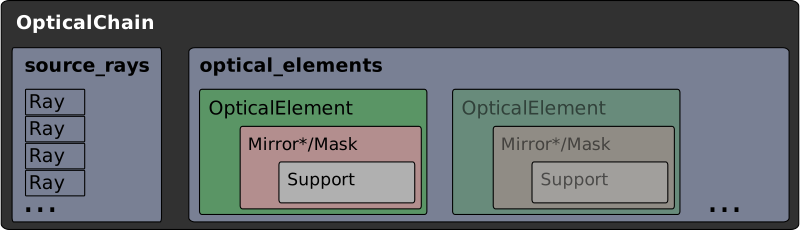
Provides the class OpticalChain, which represents the whole optical setup to be simulated, from the bundle of source-Rays through the successive OpticalElements.
Created in Jan 2022
@author: Stefan Haessler
1""" 2Provides the class OpticalChain, which represents the whole optical setup to be simulated, 3from the bundle of source-[Rays](ModuleOpticalRay.html) through the successive [OpticalElements](ModuleOpticalElement.html). 4 5 6 7 8 9Created in Jan 2022 10 11@author: Stefan Haessler 12""" 13# %% Modules 14import copy 15import numpy as np 16import logging 17 18import ARTcore.ModuleProcessing as mp 19import ARTcore.ModuleGeometry as mgeo 20import ARTcore.ModuleOpticalRay as mray 21import ARTcore.ModuleOpticalElement as moe 22import ARTcore.ModuleDetector as mdet 23import ARTcore.ModuleSource as msource 24 25logger = logging.getLogger(__name__) 26 27# %% 28class OpticalChain: 29 """ 30 The OpticalChain represents the whole optical setup to be simulated: 31 Its main attributes are a list source-[Rays](ModuleOpticalRay.html) and 32 a list of successive [OpticalElements](ModuleOpticalElement.html). 33 34 The method OpticalChain.get_output_rays() returns an associated list of lists of 35 [Rays](ModuleOpticalRay.html), each calculated by ray-tracing from one 36 [OpticalElement](ModuleOpticalElement.html) to the next. 37 So OpticalChain.get_output_rays()[i] is the bundle of [Rays](ModuleOpticalRay.html) *after* 38 optical_elements[i]. 39 40 The string "description" can contain a short description of the optical setup, or similar notes. 41 42 The OpticalChain can be visualized quickly with the method OpticalChain.quickshow(), 43 and more nicely with OpticalChain.render(). 44 45 The class also provides methods for (mis-)alignment of the source-[Ray](ModuleOpticalRay.html)-bundle and the 46 [OpticalElements](ModuleOpticalElement.html). 47 48 Attributes 49 ---------- 50 source_rays : list[mray.Ray] 51 List of source rays, which are to be traced. 52 53 optical_elements : list[moe.OpticalElement] 54 List of successive optical elements. 55 56 detector: mdet.Detector (optional) 57 The detector (or list of detectors) to analyse the results. 58 59 description : str 60 A string to describe the optical setup. 61 Methods 62 ---------- 63 copy_chain() 64 65 get_output_rays() 66 67 render() 68 69 ---------- 70 71 shift_source(axis, distance) 72 73 tilt_source(self, axis, angle) 74 75 ---------- 76 77 rotate_OE(OEindx, axis, angle) 78 79 shift_OE(OEindx, axis, distance) 80 81 """ 82 83 def __init__(self, source_rays, optical_elements, detectors, description=""): 84 """ 85 Parameters 86 ---------- 87 source_rays : list[mray.Ray] 88 List of source rays, which are to be traced. 89 90 optical_elements : list[moe.OpticalElement] 91 List of successive optical elements. 92 93 detector: mdet.Detector (optional) 94 The detector (or list of detectors) to analyse the results. 95 96 description : str, optional 97 A string to describe the optical setup. Defaults to ''. 98 99 """ 100 self.source_rays = copy.deepcopy(source_rays) 101 # deepcopy so this object doesn't get changed when the global source_rays change "outside" 102 self.optical_elements = copy.deepcopy(optical_elements) 103 # deepcopy so this object doesn't get changed when the global optical_elements changes "outside" 104 self.detectors = detectors 105 if isinstance(detectors, mdet.Detector): 106 self.detectors = {"Focus": detectors} 107 self.description = description 108 self._output_rays = None 109 self._last_source_rays_hash = None 110 self._last_optical_elements_hash = None 111 112 def __repr__(self): 113 pretty_str = "Optical setup [OpticalChain]:\n" 114 pretty_str += f" - Description: {self.description}\n" if self.description else "Description: Not provided.\n" 115 pretty_str += " - Contains the following elements:\n" 116 pretty_str += f" - Source with {len(self.source_rays)} rays at coordinate origin\n" 117 prev_pos = np.zeros(3) 118 for i, element in enumerate(self.optical_elements): 119 dist = (element.position - prev_pos).norm 120 if i == 0: 121 prev = "source" 122 else: 123 prev = f"element {i-1}" 124 pretty_str += f" - Element {i}: {element.type} at distance {round(dist)} from {prev}\n" 125 prev_pos = element.position 126 for i in self.detectors.keys(): 127 detector = self.detectors[i] 128 pretty_str += f' - Detector "{i}": {detector.type} at distance {round(detector.distance,3)} from element {detector.index % len(self.optical_elements)}\n' 129 return pretty_str 130 131 def __getitem__(self, i): 132 return self.optical_elements[i] 133 134 def __len__(self): 135 return len(self.optical_elements) 136 137 @property 138 def source_rays(self): 139 return self._source_rays 140 141 @source_rays.setter 142 def source_rays(self, source_rays): 143 if type(source_rays) == mray.RayList: 144 self._source_rays = source_rays 145 else: 146 raise TypeError("Source_rays must be a RayList object.") 147 148 @property 149 def optical_elements(self): 150 return self._optical_elements 151 152 @optical_elements.setter 153 def optical_elements(self, optical_elements): 154 if type(optical_elements) == list and all(isinstance(x, moe.OpticalElement) for x in optical_elements): 155 self._optical_elements = optical_elements 156 else: 157 raise TypeError("Optical_elements must be list of OpticalElement-objects.") 158 159 # %% METHODS ################################################################## 160 161 def __copy__(self): 162 """Return another optical chain with the same source, optical elements and description-string as this one.""" 163 return OpticalChain(self.source_rays, self.optical_elements, self.detectors, self.description) 164 165 def __deepcopy__(self, memo): 166 """Return another optical chain with the same source, optical elements and description-string as this one.""" 167 return OpticalChain(copy.deepcopy(self.source_rays), copy.deepcopy(self.optical_elements), memo+"\n"+copy.copy(self.description)) 168 169 def get_input_rays(self): 170 """ 171 Returns the list of source rays. 172 """ 173 return self.source_rays 174 175 def get_output_rays(self, force=False, **kwargs): 176 """ 177 Returns the list of (lists of) output rays, calculate them if this hasn't been done yet, 178 or if the source-ray-bundle or anything about the optical elements has changed. 179 180 This is the user-facing method to perform the ray-tracing calculation. 181 """ 182 current_source_rays_hash = hash(self.source_rays) 183 current_optical_elements_hash = mp._hash_list_of_objects(self.optical_elements) 184 if (current_source_rays_hash != self._last_source_rays_hash) or (current_optical_elements_hash != self._last_optical_elements_hash) or force: 185 print("...ray-tracing...", end="", flush=True) 186 self._output_rays = mp.RayTracingCalculation(self.source_rays, self.optical_elements, **kwargs) 187 print( 188 "\r\033[K", end="", flush=True 189 ) # move to beginning of the line with \r and then delete the whole line with \033[K 190 self._last_source_rays_hash = current_source_rays_hash 191 self._last_optical_elements_hash = current_optical_elements_hash 192 193 return self._output_rays 194 195 def get2dPoints(self, Detector = "Focus"): 196 """ 197 Returns the 2D points of the detected rays on the detector. 198 """ 199 if isinstance(Detector, str): 200 if Detector in self.detectors.keys(): 201 Detector = self.detectors[Detector] 202 else: 203 raise ValueError('The "Detector"-argument must be a name of an existing detector or a Detector-object.') 204 return Detector.get_2D_points(self.get_output_rays()[Detector.index])[0] 205 206 def get3dPoints(self, Detector = "Focus"): 207 """ 208 Returns the 3D points of the detected rays on the detector. 209 """ 210 if isinstance(Detector, str): 211 if Detector in self.detectors.keys(): 212 Detector = self.detectors[Detector] 213 else: 214 raise ValueError('The "Detector"-argument must be a name of an existing detector or a Detector-object.') 215 return Detector.get_3D_points(self.get_output_rays()[Detector.index]) 216 217 def getDelays(self, Detector = "Focus"): 218 """ 219 Returns the delays of the detected rays on the detector. 220 """ 221 if isinstance(Detector, str): 222 if Detector in self.detectors.keys(): 223 Detector = self.detectors[Detector] 224 else: 225 raise ValueError('The "Detector"-argument must be a name of an existing detector or a Detector-object.') 226 return Detector.get_Delays(self.get_output_rays()[Detector.index]) 227 228 # %% methods to (mis-)align the optical chain; just uses the corresponding methods of the OpticalElement class... 229 230 def shift_source(self, axis: str|np.ndarray, distance: float): 231 """ 232 Shift source ray bundle by distance (in mm) along the 'axis' specified as 233 a lab-frame vector (numpy-array of length 3) or as one of the strings 234 "vert", "horiz", or "random". 235 236 In the latter case, the reference is the incidence plane of the first 237 non-normal-incidence mirror after the source. If there is none, you will 238 be asked to rather specify the axis as a 3D-numpy-array. 239 240 axis = "vert" means the source position is shifted along the axis perpendicular 241 to that incidence plane, i.e. "vertically" away from the former incidence plane.. 242 243 axis = "horiz" means the source direciton is translated along thr axis in that 244 incidence plane and perpendicular to the current source direction, 245 i.e. "horizontally" in the incidence plane, but retaining the same distance 246 of source and first optical element. 247 248 axis = "random" means the the source direction shifted in a random direction 249 within in the plane perpendicular to the current source direction, 250 e.g. simulating a fluctuation of hte transverse source position. 251 252 Parameters 253 ---------- 254 axis : np.ndarray or str 255 Shift axis, specified either as a 3D lab-frame vector or as one 256 of the strings "vert", "horiz", or "random". 257 258 distance : float 259 Shift distance in mm. 260 261 Returns 262 ------- 263 Nothing, just modifies the property 'source_rays'. 264 """ 265 if type(distance) not in [int, float, np.float64]: 266 raise ValueError('The "distance"-argument must be an int or float number.') 267 268 central_ray_vector = mp.FindCentralRay(self.source_rays).vector 269 mirror_indcs = [i for i, OE in enumerate(self.optical_elements) if "Mirror" in OE.type.type] 270 271 OEnormal = None 272 for i in mirror_indcs: 273 ith_OEnormal = self.optical_elements[i].normal 274 if np.linalg.norm(np.cross(central_ray_vector, ith_OEnormal)) > 1e-10: 275 OEnormal = ith_OEnormal 276 break 277 if OEnormal is None: 278 raise Exception( 279 "There doesn't seem to be a non-normal-incidence mirror in this optical chain, \ 280 so you should rather give 'axis' as a numpy-array of length 3." 281 ) 282 283 if type(axis) == np.ndarray and len(axis) == 3: 284 translation_vector = axis 285 else: 286 perp_axis = np.cross(central_ray_vector, OEnormal) 287 horiz_axis = np.cross(perp_axis, central_ray_vector) 288 289 if axis == "vert": 290 translation_vector = perp_axis 291 elif axis == "horiz": 292 translation_vector = horiz_axis 293 elif axis == "random": 294 translation_vector = ( 295 np.random.uniform(low=-1, high=1, size=1) * perp_axis 296 + np.random.uniform(low=-1, high=1, size=1) * horiz_axis 297 ) 298 else: 299 raise ValueError( 300 'The shift direction must be specified by "axis" as one of ["vert", "horiz", "random"].' 301 ) 302 303 self.source_rays = mgeo.TranslationRayList(self.source_rays, distance * mgeo.Normalize(translation_vector)) 304 305 def tilt_source(self, axis: str|np.ndarray, angle: float): 306 """ 307 Rotate source ray bundle by angle around an axis, specified as 308 a lab-frame vector (numpy-array of length 3) or as one of the strings 309 "in_plane", "out_plane" or "random" direction. 310 311 In the latter case, the function considers the incidence plane of the first 312 non-normal-incidence mirror after the source. If there is none, you will 313 be asked to rather specify the axis as a 3D-numpy-array. 314 315 axis = "in_plane" means the source direction is rotated about an axis 316 perpendicular to that incidence plane, which tilts the source 317 "horizontally" in the same plane. 318 319 axis = "out_plane" means the source direciton is rotated about an axis 320 in that incidence plane and perpendicular to the current source direction, 321 which tilts the source "vertically" out of the former incidence plane. 322 323 axis = "random" means the the source direction is tilted in a random direction, 324 e.g. simulating a beam pointing fluctuation. 325 326 Attention, "angle" is given in deg, so as to remain consitent with the 327 conventions of other functions, although pointing is mostly talked about 328 in mrad instead. 329 330 Parameters 331 ---------- 332 axis : np.ndarray or str 333 Shift axis, specified either as a 3D lab-frame vector or as one 334 of the strings "in_plane", "out_plane", or "random". 335 336 angle : float 337 Rotation angle in degree. 338 339 Returns 340 ------- 341 Nothing, just modifies the property 'source_rays'. 342 """ 343 if type(angle) not in [int, float, np.float64]: 344 raise ValueError('The "angle"-argument must be an int or float number.') 345 346 central_ray_vector = mp.FindCentralRay(self.source_rays).vector 347 mirror_indcs = [i for i, OE in enumerate(self.optical_elements) if "Mirror" in OE.type.type] 348 349 OEnormal = None 350 for i in mirror_indcs: 351 ith_OEnormal = self.optical_elements[i].normal 352 if np.linalg.norm(np.cross(central_ray_vector, ith_OEnormal)) > 1e-10: 353 OEnormal = ith_OEnormal 354 break 355 if OEnormal is None: 356 raise Exception( 357 "There doesn't seem to be a non-normal-incidence mirror in this optical chain, \ 358 so you should rather give 'axis' as a numpy-array of length 3." 359 ) 360 361 if type(axis) == np.ndarray and len(axis) == 3: 362 rot_axis = axis 363 else: 364 rot_axis_in = np.cross(central_ray_vector, OEnormal) 365 rot_axis_out = np.cross(rot_axis_in, central_ray_vector) 366 if axis == "in_plane": 367 rot_axis = rot_axis_in 368 elif axis == "out_plane": 369 rot_axis = rot_axis_out 370 elif axis == "random": 371 rot_axis = ( 372 np.random.uniform(low=-1, high=1, size=1) * rot_axis_in 373 + np.random.uniform(low=-1, high=1, size=1) * rot_axis_out 374 ) 375 else: 376 raise ValueError( 377 'The tilt axis must be specified by as one of ["in_plane", "out_plane", "random"] or as a numpy-array of length 3.' 378 ) 379 380 self.source_rays = mgeo.RotationAroundAxisRayList(self.source_rays, rot_axis, np.deg2rad(angle)) 381 382 def partial_realign(self, OEstart: int, OEstop: int, DistanceList: list, IncidenceAngleList, IncidencePlaneAngleList): 383 """ 384 This as-of-yet not-implemented method will realign only the parts of the optical chain that are between the elements 385 OEstart and OEstop (both included). 386 """ 387 OpticsList = [i.type for i in self.optical_elements[OEstart:OEstop]] 388 outray = self.get_output_rays()[OEstart-1][0] 389 print(outray) 390 new_elements = mp.OEPlacement(OpticsList, DistanceList, IncidenceAngleList, IncidencePlaneAngleList, outray) 391 self.optical_elements[OEstart:OEstop] = new_elements 392 393 # %% 394 def rotate_OE(self, OEindx: int, ref: str, axis: str, angle: float): 395 """ 396 Rotate the optical element OpticalChain.optical_elements[OEindx] with an axis defined relative to the master ray. 397 The axis can either be relative to the incoming master ray or the outgoing one. This is defined by the "ref" variable 398 that takes either of the two values: 399 - "in" 400 - "out" 401 In either case the "axis" can take these values: 402 - "roll": Rotation about the master ray. Looking in the same direction as light propagation, positive is counterclockwise 403 - "pitch": Rotation about the vector in the incidence plane that is normal to the master ray. 404 - "yaw": Rotation about the vector normal to the incidence plane and to the master ray. 405 406 Parameters 407 ---------- 408 OEindx : int 409 Index of the optical element to modify out of OpticalChain.optical_elements. 410 411 ref : str 412 Reference ray used to define the axes of rotation. Can be either: 413 "in" or "out" or "local_normal" (in+out) 414 415 axis : str 416 Rotation axis, specified as one of the strings 417 "pitch", "roll", "yaw" 418 419 angle : float 420 Rotation angle in degree. 421 422 Returns 423 ------- 424 Nothing, just modifies OpticalChain.optical_elements[OEindx]. 425 """ 426 if abs(OEindx) > len(self.optical_elements): 427 raise ValueError( 428 'The "OEnumber"-argument is out of range compared to the length of OpticalChain.optical_elements.' 429 ) 430 if type(angle) not in [int, float, np.float64]: 431 raise ValueError('The "angle"-argument must be an int or float number.') 432 MasterRay = [mp.FindCentralRay(self.source_rays)] 433 TracedRay = mp.RayTracingCalculation(MasterRay, self.optical_elements) 434 TracedRay = [MasterRay] + TracedRay 435 match ref: 436 case "out": 437 RefVec = mgeo.Normalize(TracedRay[OEindx+1][0].vector) 438 case "in": 439 RefVec = mgeo.Normalize(TracedRay[OEindx][0].vector) 440 case "localnormal": 441 In = mgeo.Normalize(TracedRay[OEindx][0].vector) 442 Out = mgeo.Normalize(TracedRay[OEindx+1][0].vector) 443 RefVec = mgeo.Normalize(Out-In) 444 case _: 445 raise ValueError('The "ref"-argument must be a string out of ["in", "out", "localnormal].') 446 if 1 - np.dot(self[OEindx].normal,RefVec) > 1e-2: 447 match axis: 448 case "pitch": 449 self[OEindx].normal = mgeo.RotationAroundAxis(self[OEindx].majoraxis,np.deg2rad(angle),self[OEindx].normal) 450 case "roll": 451 self[OEindx].normal = mgeo.RotationAroundAxis(RefVec,np.deg2rad(angle),self[OEindx].normal) 452 case "yaw": 453 self[OEindx].normal = mgeo.RotationAroundAxis(mgeo.Normalize(np.cross(RefVec, self[OEindx].majoraxis)),np.deg2rad(angle),self[OEindx].normal) 454 case _: 455 raise ValueError('The "axis"-argument must be a string out of ["pitch", "roll", "yaw"].') 456 else: 457 #If the normal vector is aligned with the ray 458 match axis: 459 case "pitch": 460 self[OEindx].normal = mgeo.RotationAroundAxis(self[OEindx].majoraxis,np.deg2rad(angle),self[OEindx].normal) 461 case "roll": 462 self[OEindx].majoraxis = mgeo.RotationAroundAxis(self[OEindx].normal,np.deg2rad(angle),self[OEindx].majoraxis) 463 case "yaw": 464 self[OEindx].normal = mgeo.RotationAroundAxis(mgeo.Normalize(np.cross(RefVec, self[OEindx].majoraxis)),np.deg2rad(angle),self[OEindx].normal) 465 case _: 466 raise ValueError('The "axis"-argument must be a string out of ["pitch", "roll", "yaw"].') 467 468 def shift_OE(self, OEindx: int, ref: str, axis: str, distance: float): 469 """ 470 Shift the optical element OpticalChain.optical_elements[OEindx] along 471 axis referenced to the master ray. 472 473 The axis can either be relative to the incoming master ray or the outgoing one. This is defined by the "ref" variable 474 that takes either of the two values: 475 - "in" 476 - "out" 477 In either case the "axis" can take these values: 478 - "along": Translation along the master ray. 479 - "in_plane": Translation along the vector in the incidence plane that is normal to the master ray. 480 - "out_plane": Translation along the vector normal to the incidence plane and to the master ray. 481 482 Parameters 483 ---------- 484 OEindx : int 485 Index of the optical element to modify out of OpticalChain.optical_elements. 486 487 ref : str 488 Reference ray used to define the axes of rotation. Can be either: 489 "in" or "out". 490 491 axis : str 492 Translation axis, specified as one of the strings 493 "along", "in_plane", "out_plane". 494 495 distance : float 496 Rotation angle in degree. 497 498 Returns 499 ------- 500 Nothing, just modifies OpticalChain.optical_elements[OEindx]. 501 """ 502 if abs(OEindx) >= len(self.optical_elements): 503 raise ValueError( 504 'The "OEnumber"-argument is out of range compared to the length of OpticalChain.optical_elements.' 505 ) 506 if type(distance) not in [int, float, np.float64]: 507 raise ValueError('The "dist"-argument must be an int or float number.') 508 509 MasterRay = [mp.FindCentralRay(self.source_rays)] 510 TracedRay = mp.RayTracingCalculation(MasterRay, self.optical_elements) 511 TracedRay = [MasterRay] + TracedRay 512 match ref: 513 case "out": 514 RefVec = TracedRay[OEindx+1][0].vector 515 case "in": 516 RefVec = TracedRay[OEindx][0].vector 517 case _: 518 raise ValueError('The "ref"-argument must be a string out of ["in", "out"].') 519 match axis: 520 case "along": 521 self[OEindx].position = self[OEindx].position + distance * mgeo.Normalize(RefVec) 522 case "in_plane": 523 self[OEindx].position = self[OEindx].position + distance * mgeo.Normalize(np.cross(RefVec, np.cross(RefVec, self[OEindx].normal))) 524 case "out_plane": 525 self[OEindx].position = self[OEindx].position + distance * mgeo.Normalize(np.cross(RefVec, self[OEindx].normal)) 526 case _: 527 raise ValueError('The "axis"-argument must be a string out of ["along", "in_plane", "out_plane"].') 528 529 # some function that randomly misalings one, or several or all ?
 29class OpticalChain:
 30    """
 31    The OpticalChain represents the whole optical setup to be simulated:
 32    Its main attributes are a list source-[Rays](ModuleOpticalRay.html) and
 33    a list of successive [OpticalElements](ModuleOpticalElement.html).
 34
 35    The method OpticalChain.get_output_rays() returns an associated list of lists of
 36    [Rays](ModuleOpticalRay.html), each calculated by ray-tracing from one
 37    [OpticalElement](ModuleOpticalElement.html) to the next.
 38    So OpticalChain.get_output_rays()[i] is the bundle of [Rays](ModuleOpticalRay.html) *after*
 39    optical_elements[i].
 40
 41    The string "description" can contain a short description of the optical setup, or similar notes.
 42
 43    The OpticalChain can be visualized quickly with the method OpticalChain.quickshow(),
 44    and more nicely with OpticalChain.render().
 45
 46    The class also provides methods for (mis-)alignment of the source-[Ray](ModuleOpticalRay.html)-bundle and the
 47    [OpticalElements](ModuleOpticalElement.html).
 48
 49    Attributes
 50    ----------
 51        source_rays : list[mray.Ray]
 52            List of source rays, which are to be traced.
 53
 54        optical_elements : list[moe.OpticalElement]
 55            List of successive optical elements.
 56
 57        detector: mdet.Detector (optional)
 58            The detector (or list of detectors) to analyse the results.
 59
 60        description : str
 61            A string to describe the optical setup.
 62    Methods
 63    ----------
 64        copy_chain()
 65
 66        get_output_rays()
 67
 68        render()
 69
 70        ----------
 71
 72        shift_source(axis, distance)
 73
 74        tilt_source(self, axis, angle)
 75
 76        ----------
 77
 78        rotate_OE(OEindx, axis, angle)
 79
 80        shift_OE(OEindx, axis, distance)
 81
 82    """
 83
 84    def __init__(self, source_rays, optical_elements, detectors, description=""):
 85        """
 86        Parameters
 87        ----------
 88            source_rays : list[mray.Ray]
 89                List of source rays, which are to be traced.
 90
 91            optical_elements : list[moe.OpticalElement]
 92                List of successive optical elements.
 93
 94            detector: mdet.Detector (optional)
 95                The detector (or list of detectors) to analyse the results.
 96
 97            description : str, optional
 98                A string to describe the optical setup. Defaults to ''.
 99
100        """
101        self.source_rays = copy.deepcopy(source_rays)
102        # deepcopy so this object doesn't get changed when the global source_rays change "outside"
103        self.optical_elements = copy.deepcopy(optical_elements)
104        # deepcopy so this object doesn't get changed when the global optical_elements changes "outside"
105        self.detectors = detectors
106        if isinstance(detectors, mdet.Detector):
107            self.detectors = {"Focus": detectors}
108        self.description = description
109        self._output_rays = None
110        self._last_source_rays_hash = None
111        self._last_optical_elements_hash = None
112
113    def __repr__(self):
114        pretty_str = "Optical setup [OpticalChain]:\n"
115        pretty_str += f"  - Description: {self.description}\n" if self.description else "Description: Not provided.\n"
116        pretty_str +=  "  - Contains the following elements:\n"
117        pretty_str +=  f"    - Source with {len(self.source_rays)} rays at coordinate origin\n"
118        prev_pos = np.zeros(3)
119        for i, element in enumerate(self.optical_elements):
120            dist = (element.position - prev_pos).norm
121            if i == 0:
122                prev = "source"
123            else:
124                prev = f"element {i-1}"
125            pretty_str += f"    - Element {i}: {element.type} at distance {round(dist)} from {prev}\n"
126            prev_pos = element.position
127        for i in self.detectors.keys():
128            detector = self.detectors[i]
129            pretty_str += f'    - Detector "{i}": {detector.type} at distance {round(detector.distance,3)} from element {detector.index % len(self.optical_elements)}\n'
130        return pretty_str
131
132    def __getitem__(self, i):
133        return self.optical_elements[i]
134
135    def __len__(self):
136        return len(self.optical_elements)
137
138    @property
139    def source_rays(self):
140        return self._source_rays
141
142    @source_rays.setter
143    def source_rays(self, source_rays):
144        if type(source_rays) == mray.RayList:
145            self._source_rays = source_rays
146        else:
147            raise TypeError("Source_rays must be a RayList object.")
148
149    @property
150    def optical_elements(self):
151        return self._optical_elements
152
153    @optical_elements.setter
154    def optical_elements(self, optical_elements):
155        if type(optical_elements) == list and all(isinstance(x, moe.OpticalElement) for x in optical_elements):
156            self._optical_elements = optical_elements
157        else:
158            raise TypeError("Optical_elements must be list of OpticalElement-objects.")
159
160    # %% METHODS ##################################################################
161
162    def __copy__(self):
163        """Return another optical chain with the same source, optical elements and description-string as this one."""
164        return OpticalChain(self.source_rays, self.optical_elements, self.detectors, self.description)
165
166    def __deepcopy__(self, memo):
167        """Return another optical chain with the same source, optical elements and description-string as this one."""
168        return OpticalChain(copy.deepcopy(self.source_rays), copy.deepcopy(self.optical_elements), memo+"\n"+copy.copy(self.description))
169
170    def get_input_rays(self):
171        """
172        Returns the list of source rays.
173        """
174        return self.source_rays
175
176    def get_output_rays(self, force=False, **kwargs):
177        """
178        Returns the list of (lists of) output rays, calculate them if this hasn't been done yet,
179        or if the source-ray-bundle or anything about the optical elements has changed.
180
181        This is the user-facing method to perform the ray-tracing calculation.
182        """
183        current_source_rays_hash = hash(self.source_rays)
184        current_optical_elements_hash = mp._hash_list_of_objects(self.optical_elements)
185        if (current_source_rays_hash != self._last_source_rays_hash) or (current_optical_elements_hash != self._last_optical_elements_hash) or force:
186            print("...ray-tracing...", end="", flush=True)
187            self._output_rays = mp.RayTracingCalculation(self.source_rays, self.optical_elements, **kwargs)
188            print(
189                "\r\033[K", end="", flush=True
190            )  # move to beginning of the line with \r and then delete the whole line with \033[K
191            self._last_source_rays_hash = current_source_rays_hash
192            self._last_optical_elements_hash = current_optical_elements_hash
193
194        return self._output_rays
195
196    def get2dPoints(self, Detector = "Focus"):
197        """
198        Returns the 2D points of the detected rays on the detector.
199        """
200        if isinstance(Detector, str):
201            if Detector in self.detectors.keys():
202                Detector = self.detectors[Detector]
203            else:
204                raise ValueError('The "Detector"-argument must be a name of an existing detector or a Detector-object.')
205        return Detector.get_2D_points(self.get_output_rays()[Detector.index])[0]
206
207    def get3dPoints(self, Detector = "Focus"):
208        """
209        Returns the 3D points of the detected rays on the detector.
210        """
211        if isinstance(Detector, str):
212            if Detector in self.detectors.keys():
213                Detector = self.detectors[Detector]
214            else:
215                raise ValueError('The "Detector"-argument must be a name of an existing detector or a Detector-object.')
216        return Detector.get_3D_points(self.get_output_rays()[Detector.index])
217
218    def getDelays(self, Detector = "Focus"):
219        """
220        Returns the delays of the detected rays on the detector.
221        """
222        if isinstance(Detector, str):
223            if Detector in self.detectors.keys():
224                Detector = self.detectors[Detector]
225            else:
226                raise ValueError('The "Detector"-argument must be a name of an existing detector or a Detector-object.')
227        return Detector.get_Delays(self.get_output_rays()[Detector.index])
228
229    # %%  methods to (mis-)align the optical chain; just uses the corresponding methods of the OpticalElement class...
230
231    def shift_source(self, axis: str|np.ndarray, distance: float):
232        """
233        Shift source ray bundle by distance (in mm) along the 'axis' specified as
234        a lab-frame vector (numpy-array of length 3) or as one of the strings
235        "vert", "horiz", or "random".
236
237        In the latter case, the reference is the incidence plane of the first
238        non-normal-incidence mirror after the source. If there is none, you will
239        be asked to rather specify the axis as a 3D-numpy-array.
240
241        axis = "vert" means the source position is shifted along the axis perpendicular
242        to that incidence plane, i.e. "vertically" away from the former incidence plane..
243
244        axis = "horiz" means the source direciton is translated along thr axis in that
245        incidence plane and perpendicular to the current source direction,
246        i.e. "horizontally" in the incidence plane, but retaining the same distance
247        of source and first optical element.
248
249        axis = "random" means the the source direction shifted in a random direction
250        within in the plane perpendicular to the current source direction,
251        e.g. simulating a fluctuation of hte transverse source position.
252
253        Parameters
254        ----------
255            axis : np.ndarray or str
256                Shift axis, specified either as a 3D lab-frame vector or as one
257                of the strings "vert", "horiz", or "random".
258
259            distance : float
260                Shift distance in mm.
261
262        Returns
263        -------
264            Nothing, just modifies the property 'source_rays'.
265        """
266        if type(distance) not in [int, float, np.float64]:
267            raise ValueError('The "distance"-argument must be an int or float number.')
268
269        central_ray_vector = mp.FindCentralRay(self.source_rays).vector
270        mirror_indcs = [i for i, OE in enumerate(self.optical_elements) if "Mirror" in OE.type.type]
271
272        OEnormal = None
273        for i in mirror_indcs:
274            ith_OEnormal = self.optical_elements[i].normal
275            if np.linalg.norm(np.cross(central_ray_vector, ith_OEnormal)) > 1e-10:
276                OEnormal = ith_OEnormal
277                break
278        if OEnormal is None:
279            raise Exception(
280                "There doesn't seem to be a non-normal-incidence mirror in this optical chain, \
281                            so you should rather give 'axis' as a numpy-array of length 3."
282            )
283
284        if type(axis) == np.ndarray and len(axis) == 3:
285            translation_vector = axis
286        else:
287            perp_axis = np.cross(central_ray_vector, OEnormal)
288            horiz_axis = np.cross(perp_axis, central_ray_vector)
289
290            if axis == "vert":
291                translation_vector = perp_axis
292            elif axis == "horiz":
293                translation_vector = horiz_axis
294            elif axis == "random":
295                translation_vector = (
296                    np.random.uniform(low=-1, high=1, size=1) * perp_axis
297                    + np.random.uniform(low=-1, high=1, size=1) * horiz_axis
298                )
299            else:
300                raise ValueError(
301                    'The shift direction must be specified by "axis" as one of ["vert", "horiz", "random"].'
302                )
303
304        self.source_rays = mgeo.TranslationRayList(self.source_rays, distance * mgeo.Normalize(translation_vector))
305
306    def tilt_source(self, axis: str|np.ndarray, angle: float):
307        """
308        Rotate source ray bundle by angle around an axis, specified as
309        a lab-frame vector (numpy-array of length 3) or as one of the strings
310        "in_plane", "out_plane" or "random" direction.
311
312        In the latter case, the function considers the incidence plane of the first
313        non-normal-incidence mirror after the source. If there is none, you will
314        be asked to rather specify the axis as a 3D-numpy-array.
315
316        axis = "in_plane" means the source direction is rotated about an axis
317        perpendicular to that incidence plane, which tilts the source
318        "horizontally" in the same plane.
319
320        axis = "out_plane" means the source direciton is rotated about an axis
321        in that incidence plane and perpendicular to the current source direction,
322        which tilts the source "vertically" out of the former incidence plane.
323
324        axis = "random" means the the source direction is tilted in a random direction,
325        e.g. simulating a beam pointing fluctuation.
326
327        Attention, "angle" is given in deg, so as to remain consitent with the
328        conventions of other functions, although pointing is mostly talked about
329        in mrad instead.
330
331        Parameters
332        ----------
333            axis : np.ndarray or str
334                Shift axis, specified either as a 3D lab-frame vector or as one
335                of the strings "in_plane", "out_plane", or "random".
336
337            angle : float
338                Rotation angle in degree.
339
340        Returns
341        -------
342            Nothing, just modifies the property 'source_rays'.
343        """
344        if type(angle) not in [int, float, np.float64]:
345            raise ValueError('The "angle"-argument must be an int or float number.')
346
347        central_ray_vector = mp.FindCentralRay(self.source_rays).vector
348        mirror_indcs = [i for i, OE in enumerate(self.optical_elements) if "Mirror" in OE.type.type]
349
350        OEnormal = None
351        for i in mirror_indcs:
352            ith_OEnormal = self.optical_elements[i].normal
353            if np.linalg.norm(np.cross(central_ray_vector, ith_OEnormal)) > 1e-10:
354                OEnormal = ith_OEnormal
355                break
356        if OEnormal is None:
357            raise Exception(
358                "There doesn't seem to be a non-normal-incidence mirror in this optical chain, \
359                            so you should rather give 'axis' as a numpy-array of length 3."
360            )
361
362        if type(axis) == np.ndarray and len(axis) == 3:
363            rot_axis = axis
364        else:
365            rot_axis_in = np.cross(central_ray_vector, OEnormal)
366            rot_axis_out = np.cross(rot_axis_in, central_ray_vector)
367            if axis == "in_plane":
368                rot_axis = rot_axis_in
369            elif axis == "out_plane":
370                rot_axis = rot_axis_out
371            elif axis == "random":
372                rot_axis = (
373                    np.random.uniform(low=-1, high=1, size=1) * rot_axis_in
374                    + np.random.uniform(low=-1, high=1, size=1) * rot_axis_out
375                )
376            else:
377                raise ValueError(
378                    'The tilt axis must be specified by as one of ["in_plane", "out_plane", "random"] or as a numpy-array of length 3.'
379                )
380
381        self.source_rays = mgeo.RotationAroundAxisRayList(self.source_rays, rot_axis, np.deg2rad(angle))
382
383    def partial_realign(self, OEstart: int, OEstop: int, DistanceList: list, IncidenceAngleList, IncidencePlaneAngleList):
384        """
385        This as-of-yet not-implemented method will realign only the parts of the optical chain that are between the elements
386        OEstart and OEstop (both included).
387        """
388        OpticsList = [i.type for i in self.optical_elements[OEstart:OEstop]]
389        outray = self.get_output_rays()[OEstart-1][0]
390        print(outray)
391        new_elements = mp.OEPlacement(OpticsList, DistanceList, IncidenceAngleList, IncidencePlaneAngleList, outray)
392        self.optical_elements[OEstart:OEstop] = new_elements
393
394    # %%
395    def rotate_OE(self, OEindx: int, ref: str, axis: str, angle: float):
396        """
397        Rotate the optical element OpticalChain.optical_elements[OEindx] with an axis defined relative to the master ray.
398        The axis can either be relative to the incoming master ray or the outgoing one. This is defined  by the "ref" variable
399        that takes either of the two values:
400            - "in"
401            - "out"
402        In either case the "axis" can take these values:
403            - "roll": Rotation about the master ray. Looking in the same direction as light propagation, positive is counterclockwise
404            - "pitch": Rotation about the vector in the incidence plane that is normal to the master ray.
405            - "yaw": Rotation about the vector normal to the incidence plane and to the master ray.
406
407        Parameters
408        ----------
409            OEindx : int
410                Index of the optical element to modify out of OpticalChain.optical_elements.
411
412            ref : str
413                Reference ray used to define the axes of rotation. Can be either:
414                "in" or "out" or "local_normal" (in+out)
415
416            axis : str
417                Rotation axis, specified as one of the strings
418                "pitch", "roll", "yaw"
419
420            angle : float
421                Rotation angle in degree.
422
423        Returns
424        -------
425            Nothing, just modifies OpticalChain.optical_elements[OEindx].
426        """
427        if abs(OEindx) > len(self.optical_elements):
428            raise ValueError(
429                'The "OEnumber"-argument is out of range compared to the length of OpticalChain.optical_elements.'
430            )
431        if type(angle) not in [int, float, np.float64]:
432            raise ValueError('The "angle"-argument must be an int or float number.')
433        MasterRay = [mp.FindCentralRay(self.source_rays)]
434        TracedRay = mp.RayTracingCalculation(MasterRay, self.optical_elements)
435        TracedRay = [MasterRay] + TracedRay
436        match ref:
437            case "out":
438                RefVec = mgeo.Normalize(TracedRay[OEindx+1][0].vector)
439            case "in":
440                RefVec = mgeo.Normalize(TracedRay[OEindx][0].vector)
441            case "localnormal":
442                In = mgeo.Normalize(TracedRay[OEindx][0].vector)
443                Out = mgeo.Normalize(TracedRay[OEindx+1][0].vector)
444                RefVec = mgeo.Normalize(Out-In)
445            case _:
446                raise ValueError('The "ref"-argument must be a string out of ["in", "out", "localnormal].')
447        if 1 - np.dot(self[OEindx].normal,RefVec) > 1e-2:
448            match axis:
449                case "pitch":
450                    self[OEindx].normal = mgeo.RotationAroundAxis(self[OEindx].majoraxis,np.deg2rad(angle),self[OEindx].normal)
451                case "roll":
452                    self[OEindx].normal = mgeo.RotationAroundAxis(RefVec,np.deg2rad(angle),self[OEindx].normal)
453                case "yaw":
454                    self[OEindx].normal = mgeo.RotationAroundAxis(mgeo.Normalize(np.cross(RefVec, self[OEindx].majoraxis)),np.deg2rad(angle),self[OEindx].normal)
455                case _:
456                    raise ValueError('The "axis"-argument must be a string out of ["pitch", "roll", "yaw"].')
457        else:
458            #If the normal vector is aligned with the ray
459            match axis:
460                case "pitch":
461                    self[OEindx].normal = mgeo.RotationAroundAxis(self[OEindx].majoraxis,np.deg2rad(angle),self[OEindx].normal)
462                case "roll":
463                    self[OEindx].majoraxis = mgeo.RotationAroundAxis(self[OEindx].normal,np.deg2rad(angle),self[OEindx].majoraxis)
464                case "yaw":
465                    self[OEindx].normal = mgeo.RotationAroundAxis(mgeo.Normalize(np.cross(RefVec, self[OEindx].majoraxis)),np.deg2rad(angle),self[OEindx].normal)
466                case _:
467                    raise ValueError('The "axis"-argument must be a string out of ["pitch", "roll", "yaw"].')
468
469    def shift_OE(self, OEindx: int, ref: str, axis: str, distance: float):
470        """
471        Shift the optical element OpticalChain.optical_elements[OEindx] along
472        axis referenced to the master ray.
473
474        The axis can either be relative to the incoming master ray or the outgoing one. This is defined  by the "ref" variable
475        that takes either of the two values:
476            - "in"
477            - "out"
478        In either case the "axis" can take these values:
479            - "along": Translation along the master ray.
480            - "in_plane": Translation along the vector in the incidence plane that is normal to the master ray.
481            - "out_plane": Translation along the vector normal to the incidence plane and to the master ray.
482
483        Parameters
484        ----------
485            OEindx : int
486                Index of the optical element to modify out of OpticalChain.optical_elements.
487
488            ref : str
489                Reference ray used to define the axes of rotation. Can be either:
490                "in" or "out".
491
492            axis : str
493                Translation axis, specified as one of the strings
494                "along", "in_plane", "out_plane".
495
496            distance : float
497                Rotation angle in degree.
498
499        Returns
500        -------
501            Nothing, just modifies OpticalChain.optical_elements[OEindx].
502        """
503        if abs(OEindx) >= len(self.optical_elements):
504            raise ValueError(
505                'The "OEnumber"-argument is out of range compared to the length of OpticalChain.optical_elements.'
506            )
507        if type(distance) not in [int, float, np.float64]:
508            raise ValueError('The "dist"-argument must be an int or float number.')
509
510        MasterRay = [mp.FindCentralRay(self.source_rays)]
511        TracedRay = mp.RayTracingCalculation(MasterRay, self.optical_elements)
512        TracedRay = [MasterRay] + TracedRay
513        match ref:
514            case "out":
515                RefVec = TracedRay[OEindx+1][0].vector
516            case "in":
517                RefVec = TracedRay[OEindx][0].vector
518            case _:
519                raise ValueError('The "ref"-argument must be a string out of ["in", "out"].')
520        match axis:
521            case "along":
522                self[OEindx].position = self[OEindx].position + distance * mgeo.Normalize(RefVec)
523            case "in_plane":
524                self[OEindx].position = self[OEindx].position + distance * mgeo.Normalize(np.cross(RefVec, np.cross(RefVec, self[OEindx].normal)))
525            case "out_plane":
526                self[OEindx].position = self[OEindx].position + distance * mgeo.Normalize(np.cross(RefVec, self[OEindx].normal))
527            case _:
528                raise ValueError('The "axis"-argument must be a string out of ["along", "in_plane", "out_plane"].')
529
530        # some function that randomly misalings one, or several or all ?
The OpticalChain represents the whole optical setup to be simulated: Its main attributes are a list source-Rays and a list of successive OpticalElements.
The method OpticalChain.get_output_rays() returns an associated list of lists of Rays, each calculated by ray-tracing from one OpticalElement to the next. So OpticalChain.get_output_rays()[i] is the bundle of Rays after optical_elements[i].
The string "description" can contain a short description of the optical setup, or similar notes.
The OpticalChain can be visualized quickly with the method OpticalChain.quickshow(), and more nicely with OpticalChain.render().
The class also provides methods for (mis-)alignment of the source-Ray-bundle and the OpticalElements.
Attributes
source_rays : list[mray.Ray]
    List of source rays, which are to be traced.

optical_elements : list[moe.OpticalElement]
    List of successive optical elements.

detector: mdet.Detector (optional)
    The detector (or list of detectors) to analyse the results.

description : str
    A string to describe the optical setup.
Methods
copy_chain()

get_output_rays()

render()

----------

shift_source(axis, distance)

tilt_source(self, axis, angle)

----------

rotate_OE(OEindx, axis, angle)

shift_OE(OEindx, axis, distance)
 84    def __init__(self, source_rays, optical_elements, detectors, description=""):
 85        """
 86        Parameters
 87        ----------
 88            source_rays : list[mray.Ray]
 89                List of source rays, which are to be traced.
 90
 91            optical_elements : list[moe.OpticalElement]
 92                List of successive optical elements.
 93
 94            detector: mdet.Detector (optional)
 95                The detector (or list of detectors) to analyse the results.
 96
 97            description : str, optional
 98                A string to describe the optical setup. Defaults to ''.
 99
100        """
101        self.source_rays = copy.deepcopy(source_rays)
102        # deepcopy so this object doesn't get changed when the global source_rays change "outside"
103        self.optical_elements = copy.deepcopy(optical_elements)
104        # deepcopy so this object doesn't get changed when the global optical_elements changes "outside"
105        self.detectors = detectors
106        if isinstance(detectors, mdet.Detector):
107            self.detectors = {"Focus": detectors}
108        self.description = description
109        self._output_rays = None
110        self._last_source_rays_hash = None
111        self._last_optical_elements_hash = None
Parameters
source_rays : list[mray.Ray]
    List of source rays, which are to be traced.

optical_elements : list[moe.OpticalElement]
    List of successive optical elements.

detector: mdet.Detector (optional)
    The detector (or list of detectors) to analyse the results.

description : str, optional
    A string to describe the optical setup. Defaults to ''.
170    def get_input_rays(self):
171        """
172        Returns the list of source rays.
173        """
174        return self.source_rays
Returns the list of source rays.
176    def get_output_rays(self, force=False, **kwargs):
177        """
178        Returns the list of (lists of) output rays, calculate them if this hasn't been done yet,
179        or if the source-ray-bundle or anything about the optical elements has changed.
180
181        This is the user-facing method to perform the ray-tracing calculation.
182        """
183        current_source_rays_hash = hash(self.source_rays)
184        current_optical_elements_hash = mp._hash_list_of_objects(self.optical_elements)
185        if (current_source_rays_hash != self._last_source_rays_hash) or (current_optical_elements_hash != self._last_optical_elements_hash) or force:
186            print("...ray-tracing...", end="", flush=True)
187            self._output_rays = mp.RayTracingCalculation(self.source_rays, self.optical_elements, **kwargs)
188            print(
189                "\r\033[K", end="", flush=True
190            )  # move to beginning of the line with \r and then delete the whole line with \033[K
191            self._last_source_rays_hash = current_source_rays_hash
192            self._last_optical_elements_hash = current_optical_elements_hash
193
194        return self._output_rays
Returns the list of (lists of) output rays, calculate them if this hasn't been done yet, or if the source-ray-bundle or anything about the optical elements has changed.
This is the user-facing method to perform the ray-tracing calculation.
196    def get2dPoints(self, Detector = "Focus"):
197        """
198        Returns the 2D points of the detected rays on the detector.
199        """
200        if isinstance(Detector, str):
201            if Detector in self.detectors.keys():
202                Detector = self.detectors[Detector]
203            else:
204                raise ValueError('The "Detector"-argument must be a name of an existing detector or a Detector-object.')
205        return Detector.get_2D_points(self.get_output_rays()[Detector.index])[0]
Returns the 2D points of the detected rays on the detector.
207    def get3dPoints(self, Detector = "Focus"):
208        """
209        Returns the 3D points of the detected rays on the detector.
210        """
211        if isinstance(Detector, str):
212            if Detector in self.detectors.keys():
213                Detector = self.detectors[Detector]
214            else:
215                raise ValueError('The "Detector"-argument must be a name of an existing detector or a Detector-object.')
216        return Detector.get_3D_points(self.get_output_rays()[Detector.index])
Returns the 3D points of the detected rays on the detector.
218    def getDelays(self, Detector = "Focus"):
219        """
220        Returns the delays of the detected rays on the detector.
221        """
222        if isinstance(Detector, str):
223            if Detector in self.detectors.keys():
224                Detector = self.detectors[Detector]
225            else:
226                raise ValueError('The "Detector"-argument must be a name of an existing detector or a Detector-object.')
227        return Detector.get_Delays(self.get_output_rays()[Detector.index])
Returns the delays of the detected rays on the detector.
231    def shift_source(self, axis: str|np.ndarray, distance: float):
232        """
233        Shift source ray bundle by distance (in mm) along the 'axis' specified as
234        a lab-frame vector (numpy-array of length 3) or as one of the strings
235        "vert", "horiz", or "random".
236
237        In the latter case, the reference is the incidence plane of the first
238        non-normal-incidence mirror after the source. If there is none, you will
239        be asked to rather specify the axis as a 3D-numpy-array.
240
241        axis = "vert" means the source position is shifted along the axis perpendicular
242        to that incidence plane, i.e. "vertically" away from the former incidence plane..
243
244        axis = "horiz" means the source direciton is translated along thr axis in that
245        incidence plane and perpendicular to the current source direction,
246        i.e. "horizontally" in the incidence plane, but retaining the same distance
247        of source and first optical element.
248
249        axis = "random" means the the source direction shifted in a random direction
250        within in the plane perpendicular to the current source direction,
251        e.g. simulating a fluctuation of hte transverse source position.
252
253        Parameters
254        ----------
255            axis : np.ndarray or str
256                Shift axis, specified either as a 3D lab-frame vector or as one
257                of the strings "vert", "horiz", or "random".
258
259            distance : float
260                Shift distance in mm.
261
262        Returns
263        -------
264            Nothing, just modifies the property 'source_rays'.
265        """
266        if type(distance) not in [int, float, np.float64]:
267            raise ValueError('The "distance"-argument must be an int or float number.')
268
269        central_ray_vector = mp.FindCentralRay(self.source_rays).vector
270        mirror_indcs = [i for i, OE in enumerate(self.optical_elements) if "Mirror" in OE.type.type]
271
272        OEnormal = None
273        for i in mirror_indcs:
274            ith_OEnormal = self.optical_elements[i].normal
275            if np.linalg.norm(np.cross(central_ray_vector, ith_OEnormal)) > 1e-10:
276                OEnormal = ith_OEnormal
277                break
278        if OEnormal is None:
279            raise Exception(
280                "There doesn't seem to be a non-normal-incidence mirror in this optical chain, \
281                            so you should rather give 'axis' as a numpy-array of length 3."
282            )
283
284        if type(axis) == np.ndarray and len(axis) == 3:
285            translation_vector = axis
286        else:
287            perp_axis = np.cross(central_ray_vector, OEnormal)
288            horiz_axis = np.cross(perp_axis, central_ray_vector)
289
290            if axis == "vert":
291                translation_vector = perp_axis
292            elif axis == "horiz":
293                translation_vector = horiz_axis
294            elif axis == "random":
295                translation_vector = (
296                    np.random.uniform(low=-1, high=1, size=1) * perp_axis
297                    + np.random.uniform(low=-1, high=1, size=1) * horiz_axis
298                )
299            else:
300                raise ValueError(
301                    'The shift direction must be specified by "axis" as one of ["vert", "horiz", "random"].'
302                )
303
304        self.source_rays = mgeo.TranslationRayList(self.source_rays, distance * mgeo.Normalize(translation_vector))
Shift source ray bundle by distance (in mm) along the 'axis' specified as a lab-frame vector (numpy-array of length 3) or as one of the strings "vert", "horiz", or "random".
In the latter case, the reference is the incidence plane of the first non-normal-incidence mirror after the source. If there is none, you will be asked to rather specify the axis as a 3D-numpy-array.
axis = "vert" means the source position is shifted along the axis perpendicular to that incidence plane, i.e. "vertically" away from the former incidence plane..
axis = "horiz" means the source direciton is translated along thr axis in that incidence plane and perpendicular to the current source direction, i.e. "horizontally" in the incidence plane, but retaining the same distance of source and first optical element.
axis = "random" means the the source direction shifted in a random direction within in the plane perpendicular to the current source direction, e.g. simulating a fluctuation of hte transverse source position.
Parameters
axis : np.ndarray or str
    Shift axis, specified either as a 3D lab-frame vector or as one
    of the strings "vert", "horiz", or "random".

distance : float
    Shift distance in mm.
Returns
Nothing, just modifies the property 'source_rays'.
306    def tilt_source(self, axis: str|np.ndarray, angle: float):
307        """
308        Rotate source ray bundle by angle around an axis, specified as
309        a lab-frame vector (numpy-array of length 3) or as one of the strings
310        "in_plane", "out_plane" or "random" direction.
311
312        In the latter case, the function considers the incidence plane of the first
313        non-normal-incidence mirror after the source. If there is none, you will
314        be asked to rather specify the axis as a 3D-numpy-array.
315
316        axis = "in_plane" means the source direction is rotated about an axis
317        perpendicular to that incidence plane, which tilts the source
318        "horizontally" in the same plane.
319
320        axis = "out_plane" means the source direciton is rotated about an axis
321        in that incidence plane and perpendicular to the current source direction,
322        which tilts the source "vertically" out of the former incidence plane.
323
324        axis = "random" means the the source direction is tilted in a random direction,
325        e.g. simulating a beam pointing fluctuation.
326
327        Attention, "angle" is given in deg, so as to remain consitent with the
328        conventions of other functions, although pointing is mostly talked about
329        in mrad instead.
330
331        Parameters
332        ----------
333            axis : np.ndarray or str
334                Shift axis, specified either as a 3D lab-frame vector or as one
335                of the strings "in_plane", "out_plane", or "random".
336
337            angle : float
338                Rotation angle in degree.
339
340        Returns
341        -------
342            Nothing, just modifies the property 'source_rays'.
343        """
344        if type(angle) not in [int, float, np.float64]:
345            raise ValueError('The "angle"-argument must be an int or float number.')
346
347        central_ray_vector = mp.FindCentralRay(self.source_rays).vector
348        mirror_indcs = [i for i, OE in enumerate(self.optical_elements) if "Mirror" in OE.type.type]
349
350        OEnormal = None
351        for i in mirror_indcs:
352            ith_OEnormal = self.optical_elements[i].normal
353            if np.linalg.norm(np.cross(central_ray_vector, ith_OEnormal)) > 1e-10:
354                OEnormal = ith_OEnormal
355                break
356        if OEnormal is None:
357            raise Exception(
358                "There doesn't seem to be a non-normal-incidence mirror in this optical chain, \
359                            so you should rather give 'axis' as a numpy-array of length 3."
360            )
361
362        if type(axis) == np.ndarray and len(axis) == 3:
363            rot_axis = axis
364        else:
365            rot_axis_in = np.cross(central_ray_vector, OEnormal)
366            rot_axis_out = np.cross(rot_axis_in, central_ray_vector)
367            if axis == "in_plane":
368                rot_axis = rot_axis_in
369            elif axis == "out_plane":
370                rot_axis = rot_axis_out
371            elif axis == "random":
372                rot_axis = (
373                    np.random.uniform(low=-1, high=1, size=1) * rot_axis_in
374                    + np.random.uniform(low=-1, high=1, size=1) * rot_axis_out
375                )
376            else:
377                raise ValueError(
378                    'The tilt axis must be specified by as one of ["in_plane", "out_plane", "random"] or as a numpy-array of length 3.'
379                )
380
381        self.source_rays = mgeo.RotationAroundAxisRayList(self.source_rays, rot_axis, np.deg2rad(angle))
Rotate source ray bundle by angle around an axis, specified as a lab-frame vector (numpy-array of length 3) or as one of the strings "in_plane", "out_plane" or "random" direction.
In the latter case, the function considers the incidence plane of the first non-normal-incidence mirror after the source. If there is none, you will be asked to rather specify the axis as a 3D-numpy-array.
axis = "in_plane" means the source direction is rotated about an axis perpendicular to that incidence plane, which tilts the source "horizontally" in the same plane.
axis = "out_plane" means the source direciton is rotated about an axis in that incidence plane and perpendicular to the current source direction, which tilts the source "vertically" out of the former incidence plane.
axis = "random" means the the source direction is tilted in a random direction, e.g. simulating a beam pointing fluctuation.
Attention, "angle" is given in deg, so as to remain consitent with the conventions of other functions, although pointing is mostly talked about in mrad instead.
Parameters
axis : np.ndarray or str
    Shift axis, specified either as a 3D lab-frame vector or as one
    of the strings "in_plane", "out_plane", or "random".

angle : float
    Rotation angle in degree.
Returns
Nothing, just modifies the property 'source_rays'.
383    def partial_realign(self, OEstart: int, OEstop: int, DistanceList: list, IncidenceAngleList, IncidencePlaneAngleList):
384        """
385        This as-of-yet not-implemented method will realign only the parts of the optical chain that are between the elements
386        OEstart and OEstop (both included).
387        """
388        OpticsList = [i.type for i in self.optical_elements[OEstart:OEstop]]
389        outray = self.get_output_rays()[OEstart-1][0]
390        print(outray)
391        new_elements = mp.OEPlacement(OpticsList, DistanceList, IncidenceAngleList, IncidencePlaneAngleList, outray)
392        self.optical_elements[OEstart:OEstop] = new_elements
This as-of-yet not-implemented method will realign only the parts of the optical chain that are between the elements OEstart and OEstop (both included).
395    def rotate_OE(self, OEindx: int, ref: str, axis: str, angle: float):
396        """
397        Rotate the optical element OpticalChain.optical_elements[OEindx] with an axis defined relative to the master ray.
398        The axis can either be relative to the incoming master ray or the outgoing one. This is defined  by the "ref" variable
399        that takes either of the two values:
400            - "in"
401            - "out"
402        In either case the "axis" can take these values:
403            - "roll": Rotation about the master ray. Looking in the same direction as light propagation, positive is counterclockwise
404            - "pitch": Rotation about the vector in the incidence plane that is normal to the master ray.
405            - "yaw": Rotation about the vector normal to the incidence plane and to the master ray.
406
407        Parameters
408        ----------
409            OEindx : int
410                Index of the optical element to modify out of OpticalChain.optical_elements.
411
412            ref : str
413                Reference ray used to define the axes of rotation. Can be either:
414                "in" or "out" or "local_normal" (in+out)
415
416            axis : str
417                Rotation axis, specified as one of the strings
418                "pitch", "roll", "yaw"
419
420            angle : float
421                Rotation angle in degree.
422
423        Returns
424        -------
425            Nothing, just modifies OpticalChain.optical_elements[OEindx].
426        """
427        if abs(OEindx) > len(self.optical_elements):
428            raise ValueError(
429                'The "OEnumber"-argument is out of range compared to the length of OpticalChain.optical_elements.'
430            )
431        if type(angle) not in [int, float, np.float64]:
432            raise ValueError('The "angle"-argument must be an int or float number.')
433        MasterRay = [mp.FindCentralRay(self.source_rays)]
434        TracedRay = mp.RayTracingCalculation(MasterRay, self.optical_elements)
435        TracedRay = [MasterRay] + TracedRay
436        match ref:
437            case "out":
438                RefVec = mgeo.Normalize(TracedRay[OEindx+1][0].vector)
439            case "in":
440                RefVec = mgeo.Normalize(TracedRay[OEindx][0].vector)
441            case "localnormal":
442                In = mgeo.Normalize(TracedRay[OEindx][0].vector)
443                Out = mgeo.Normalize(TracedRay[OEindx+1][0].vector)
444                RefVec = mgeo.Normalize(Out-In)
445            case _:
446                raise ValueError('The "ref"-argument must be a string out of ["in", "out", "localnormal].')
447        if 1 - np.dot(self[OEindx].normal,RefVec) > 1e-2:
448            match axis:
449                case "pitch":
450                    self[OEindx].normal = mgeo.RotationAroundAxis(self[OEindx].majoraxis,np.deg2rad(angle),self[OEindx].normal)
451                case "roll":
452                    self[OEindx].normal = mgeo.RotationAroundAxis(RefVec,np.deg2rad(angle),self[OEindx].normal)
453                case "yaw":
454                    self[OEindx].normal = mgeo.RotationAroundAxis(mgeo.Normalize(np.cross(RefVec, self[OEindx].majoraxis)),np.deg2rad(angle),self[OEindx].normal)
455                case _:
456                    raise ValueError('The "axis"-argument must be a string out of ["pitch", "roll", "yaw"].')
457        else:
458            #If the normal vector is aligned with the ray
459            match axis:
460                case "pitch":
461                    self[OEindx].normal = mgeo.RotationAroundAxis(self[OEindx].majoraxis,np.deg2rad(angle),self[OEindx].normal)
462                case "roll":
463                    self[OEindx].majoraxis = mgeo.RotationAroundAxis(self[OEindx].normal,np.deg2rad(angle),self[OEindx].majoraxis)
464                case "yaw":
465                    self[OEindx].normal = mgeo.RotationAroundAxis(mgeo.Normalize(np.cross(RefVec, self[OEindx].majoraxis)),np.deg2rad(angle),self[OEindx].normal)
466                case _:
467                    raise ValueError('The "axis"-argument must be a string out of ["pitch", "roll", "yaw"].')
Rotate the optical element OpticalChain.optical_elements[OEindx] with an axis defined relative to the master ray. The axis can either be relative to the incoming master ray or the outgoing one. This is defined by the "ref" variable that takes either of the two values: - "in" - "out" In either case the "axis" can take these values: - "roll": Rotation about the master ray. Looking in the same direction as light propagation, positive is counterclockwise - "pitch": Rotation about the vector in the incidence plane that is normal to the master ray. - "yaw": Rotation about the vector normal to the incidence plane and to the master ray.
Parameters
OEindx : int
    Index of the optical element to modify out of OpticalChain.optical_elements.

ref : str
    Reference ray used to define the axes of rotation. Can be either:
    "in" or "out" or "local_normal" (in+out)

axis : str
    Rotation axis, specified as one of the strings
    "pitch", "roll", "yaw"

angle : float
    Rotation angle in degree.
Returns
Nothing, just modifies OpticalChain.optical_elements[OEindx].
469    def shift_OE(self, OEindx: int, ref: str, axis: str, distance: float):
470        """
471        Shift the optical element OpticalChain.optical_elements[OEindx] along
472        axis referenced to the master ray.
473
474        The axis can either be relative to the incoming master ray or the outgoing one. This is defined  by the "ref" variable
475        that takes either of the two values:
476            - "in"
477            - "out"
478        In either case the "axis" can take these values:
479            - "along": Translation along the master ray.
480            - "in_plane": Translation along the vector in the incidence plane that is normal to the master ray.
481            - "out_plane": Translation along the vector normal to the incidence plane and to the master ray.
482
483        Parameters
484        ----------
485            OEindx : int
486                Index of the optical element to modify out of OpticalChain.optical_elements.
487
488            ref : str
489                Reference ray used to define the axes of rotation. Can be either:
490                "in" or "out".
491
492            axis : str
493                Translation axis, specified as one of the strings
494                "along", "in_plane", "out_plane".
495
496            distance : float
497                Rotation angle in degree.
498
499        Returns
500        -------
501            Nothing, just modifies OpticalChain.optical_elements[OEindx].
502        """
503        if abs(OEindx) >= len(self.optical_elements):
504            raise ValueError(
505                'The "OEnumber"-argument is out of range compared to the length of OpticalChain.optical_elements.'
506            )
507        if type(distance) not in [int, float, np.float64]:
508            raise ValueError('The "dist"-argument must be an int or float number.')
509
510        MasterRay = [mp.FindCentralRay(self.source_rays)]
511        TracedRay = mp.RayTracingCalculation(MasterRay, self.optical_elements)
512        TracedRay = [MasterRay] + TracedRay
513        match ref:
514            case "out":
515                RefVec = TracedRay[OEindx+1][0].vector
516            case "in":
517                RefVec = TracedRay[OEindx][0].vector
518            case _:
519                raise ValueError('The "ref"-argument must be a string out of ["in", "out"].')
520        match axis:
521            case "along":
522                self[OEindx].position = self[OEindx].position + distance * mgeo.Normalize(RefVec)
523            case "in_plane":
524                self[OEindx].position = self[OEindx].position + distance * mgeo.Normalize(np.cross(RefVec, np.cross(RefVec, self[OEindx].normal)))
525            case "out_plane":
526                self[OEindx].position = self[OEindx].position + distance * mgeo.Normalize(np.cross(RefVec, self[OEindx].normal))
527            case _:
528                raise ValueError('The "axis"-argument must be a string out of ["along", "in_plane", "out_plane"].')
529
530        # some function that randomly misalings one, or several or all ?
Shift the optical element OpticalChain.optical_elements[OEindx] along axis referenced to the master ray.
The axis can either be relative to the incoming master ray or the outgoing one. This is defined by the "ref" variable that takes either of the two values: - "in" - "out" In either case the "axis" can take these values: - "along": Translation along the master ray. - "in_plane": Translation along the vector in the incidence plane that is normal to the master ray. - "out_plane": Translation along the vector normal to the incidence plane and to the master ray.
Parameters
OEindx : int
    Index of the optical element to modify out of OpticalChain.optical_elements.

ref : str
    Reference ray used to define the axes of rotation. Can be either:
    "in" or "out".

axis : str
    Translation axis, specified as one of the strings
    "along", "in_plane", "out_plane".

distance : float
    Rotation angle in degree.
Returns
Nothing, just modifies OpticalChain.optical_elements[OEindx].
67def _getETransmission(OpticalChain, IndexIn=0, IndexOut=-1) -> float:
68    """
69    Calculates the energy transmission from the input to the output of the OpticalChain in percent.
70
71    Parameters
72    ----------
73        OpticalChain : OpticalChain
74            An object of the ModuleOpticalChain.OpticalChain-class.
75
76        IndexIn : int, optional
77            Index of the input RayList in the OpticalChain, defaults to 0.
78
79        IndexOut : int, optional
80            Index of the output RayList in the OpticalChain, defaults to -1.
81
82    Returns
83    -------
84        ETransmission : float
85    """
86    Rays = OpticalChain.get_output_rays()
87    if IndexIn == 0:
88        RayListIn = OpticalChain.get_input_rays()
89    else:
90        RayListIn = Rays[IndexIn]
91    RayListOut = Rays[IndexOut]
92    ETransmission = GetETransmission(RayListIn, RayListOut)
93    return ETransmission
Calculates the energy transmission from the input to the output of the OpticalChain in percent.
Parameters
OpticalChain : OpticalChain
    An object of the ModuleOpticalChain.OpticalChain-class.

IndexIn : int, optional
    Index of the input RayList in the OpticalChain, defaults to 0.

IndexOut : int, optional
    Index of the output RayList in the OpticalChain, defaults to -1.
Returns
ETransmission : float
147def _getResultsSummary(OpticalChain, Detector = "Focus", verbose=False):
148    """
149    Calculate and return FocalSpotSize-standard-deviation and Duration-standard-deviation
150    for the given Detector and RayList.
151    If verbose, then also print a summary of the results for the given Detector.
152
153    Parameters
154    ----------
155        OpticalChain : OpticalChain
156            An object of the ModuleOpticalChain.OpticalChain-class.
157
158        Detector : Detector or str, optional
159            An object of the ModuleDetector.Detector-class or "Focus" to use the focus detector, defaults to "Focus".
160
161        verbose : bool
162            Whether to print a result summary.
163
164    Returns
165    -------
166        FocalSpotSizeSD : float
167
168        DurationSD : float
169    """
170    if isinstance(Detector, str):
171        Detector = OpticalChain.detectors[Detector]
172    Index = Detector.index
173    RayListAnalysed = OpticalChain.get_output_rays()[Index]
174    FocalSpotSizeSD, DurationSD = GetResultSummary(Detector, RayListAnalysed, verbose)
175    return FocalSpotSizeSD, DurationSD
Calculate and return FocalSpotSize-standard-deviation and Duration-standard-deviation for the given Detector and RayList. If verbose, then also print a summary of the results for the given Detector.
Parameters
OpticalChain : OpticalChain
    An object of the ModuleOpticalChain.OpticalChain-class.

Detector : Detector or str, optional
    An object of the ModuleDetector.Detector-class or "Focus" to use the focus detector, defaults to "Focus".

verbose : bool
    Whether to print a result summary.
Returns
FocalSpotSizeSD : float

DurationSD : float
 57def DrawSpotDiagram(OpticalChain,
 58                Detector = "Focus",
 59                DrawAiryAndFourier=False,
 60                DrawFocalContour=False,
 61                DrawFocal=False,
 62                ColorCoded=None,
 63                Observer = None) -> plt.Figure:
 64    """
 65    Produce an interactive figure with the spot diagram on the selected Detector.
 66    The detector distance can be shifted with the left-right cursor keys. Doing so will actually move the detector.
 67    If DrawAiryAndFourier is True, a circle with the Airy-spot-size will be shown.
 68    If DrawFocalContour is True, the focal contour calculated from some of the rays will be shown.
 69    If DrawFocal is True, a heatmap calculated from some of the rays will be shown.
 70    The 'spots' can optionally be color-coded by specifying ColorCoded, which can be one of ["Intensity","Incidence","Delay"].
 71
 72    Parameters
 73    ----------
 74        RayListAnalysed : list(Ray)
 75            List of objects of the ModuleOpticalRay.Ray-class.
 76
 77        Detector : Detector or str, optional
 78            An object of the ModuleDetector.Detector-class or the name of the detector. The default is "Focus".
 79
 80        DrawAiryAndFourier : bool, optional
 81            Whether to draw a circle with the Airy-spot-size. The default is False.
 82
 83        DrawFocalContour : bool, optional
 84            Whether to draw the focal contour. The default is False.
 85
 86        DrawFocal : bool, optional
 87            Whether to draw the focal heatmap. The default is False.
 88
 89        ColorCoded : str, optional
 90            Color-code the spots according to one of ["Intensity","Incidence","Delay"]. The default is None.
 91
 92        Observer : Observer, optional
 93            An observer object. If none, then we just create a copy of the detector and move it when pressing left-right.
 94            However, if an observer is specified, then we will change the value of the observer and it will issue
 95            the required callbacks to update several plots at the same time.
 96
 97    Returns
 98    -------
 99        fig : matlplotlib-figure-handle.
100            Shows the interactive figure.
101    """
102    if isinstance(Detector, str):
103        Detector = OpticalChain.detectors[Detector]
104    Index = Detector.index
105    movingDetector = copy(Detector) # We will move this detector when pressing left-right
106    if Observer is None:
107        detectorPosition = Observable(movingDetector.distance) # We will observe the distance of this detector
108    else:
109        detectorPosition = Observer
110        movingDetector.distance = detectorPosition.value
111
112    detectorPosition.register_calculation(lambda x: movingDetector.set_distance(x))
113
114    RayListAnalysed = OpticalChain.get_output_rays()[Index]
115
116    NumericalAperture = man.GetNumericalAperture(RayListAnalysed, 1)  # NA determined from final ray bundle
117    MaxWavelength = np.max([i.wavelength for i in RayListAnalysed])
118    if DrawAiryAndFourier:
119        AiryRadius = man.GetAiryRadius(MaxWavelength, NumericalAperture) * 1e3  # in µm
120    else:
121        AiryRadius = 0
122
123    if DrawFocalContour or DrawFocal:
124        X,Y,Z = man.GetDiffractionFocus(OpticalChain, movingDetector, Index)
125        Z/=np.max(Z)
126
127    DectectorPoint2D_Xcoord, DectectorPoint2D_Ycoord, FocalSpotSize, SpotSizeSD = mpu._getDetectorPoints(
128        RayListAnalysed, movingDetector
129    )
130
131    match ColorCoded:
132        case "Intensity":
133            IntensityList = [k.intensity for k in RayListAnalysed]
134            z = np.asarray(IntensityList)
135            zlabel = "Intensity (arb.u.)"
136            title = "Intensity + Spot Diagram\n press left/right to move detector position"
137            addLine = ""
138        case "Incidence":
139            IncidenceList = [np.rad2deg(k.incidence) for k in RayListAnalysed]  # degree
140            z = np.asarray(IncidenceList)
141            zlabel = "Incidence angle (deg)"
142            title = "Ray Incidence + Spot Diagram\n press left/right to move detector position"
143            addLine = ""
144        case "Delay":
145            DelayList = movingDetector.get_Delays(RayListAnalysed)
146            IntensityList = [k.intensity for k in RayListAnalysed]
147            DurationSD = mp.WeightedStandardDeviation(DelayList,IntensityList)
148            #DurationSD = mp.StandardDeviation(DelayList)
149            z = np.asarray(DelayList)
150            zlabel = "Delay (fs)"
151            title = "Delay + Spot Diagram\n press left/right to move detector position"
152            addLine = "\n" + "{:.2f}".format(DurationSD) + " fs SD"
153        case _:
154            z = "red"
155            title = "Spot Diagram\n press left/right to move detector position"
156            addLine = ""
157
158    distStep = min(50, max(0.0005, round(FocalSpotSize / 8 / np.arcsin(NumericalAperture) * 10000) / 10000))  # in mm
159
160    plt.ion()
161    fig, ax = plt.subplots()
162    if DrawFocal:
163        focal = ax.pcolormesh(X*1e3,Y*1e3,Z)
164    if DrawFocalContour:
165        levels = [1/np.e**2, 0.5]
166        contour = ax.contourf(X*1e3, Y*1e3, Z, levels=levels, cmap='gray')
167
168    if DrawAiryAndFourier:
169        theta = np.linspace(0, 2 * np.pi, 100)
170        x = AiryRadius * np.cos(theta)
171        y = AiryRadius * np.sin(theta)  #
172        ax.plot(x, y, c="black")
173
174
175    foo = ax.scatter(
176        DectectorPoint2D_Xcoord,
177        DectectorPoint2D_Ycoord,
178        c=z,
179        s=15,
180        label="{:.3f}".format(detectorPosition.value) + " mm\n" + "{:.1f}".format(SpotSizeSD * 1e3) + " \u03BCm SD" + addLine,
181    )
182
183    axisLim = 1.1 * max(AiryRadius, 0.5 * FocalSpotSize * 1000)
184    ax.set_xlim(-axisLim, axisLim)
185    ax.set_ylim(-axisLim, axisLim)
186
187    if ColorCoded == "Intensity" or ColorCoded == "Incidence" or ColorCoded == "Delay":
188        cbar = fig.colorbar(foo)
189        cbar.set_label(zlabel)
190
191    ax.legend(loc="upper right")
192    ax.set_xlabel("X (µm)")
193    ax.set_ylabel("Y (µm)")
194    ax.set_title(title)
195    # ax.margins(x=0)
196
197
198    def update_plot(new_value):
199        nonlocal movingDetector, ColorCoded, zlabel, cbar, detectorPosition, foo, distStep, focal, contour, levels, Index, RayListAnalysed
200
201        newDectectorPoint2D_Xcoord, newDectectorPoint2D_Ycoord, newFocalSpotSize, newSpotSizeSD = mpu._getDetectorPoints(
202            RayListAnalysed, movingDetector
203        )
204
205        if DrawFocal:
206            focal.set_array(Z)
207        if DrawFocalContour:
208            levels = [1/np.e**2, 0.5]
209            for coll in contour.collections:
210                coll.remove()  # Remove old contour lines
211            contour = ax.contourf(X * 1e3, Y * 1e3, Z, levels=levels, cmap='gray')
212
213        xy = foo.get_offsets()
214        xy[:, 0] = newDectectorPoint2D_Xcoord
215        xy[:, 1] = newDectectorPoint2D_Ycoord
216        foo.set_offsets(xy)
217
218
219        if ColorCoded == "Delay":
220            newDelayList = np.asarray(movingDetector.get_Delays(RayListAnalysed))
221            newDurationSD = mp.WeightedStandardDeviation(newDelayList,IntensityList)
222            #newDurationSD = mp.StandardDeviation(newDelayList)
223            newaddLine = "\n" + "{:.2f}".format(newDurationSD) + " fs SD"
224            foo.set_array(newDelayList)
225            foo.set_clim(min(newDelayList), max(newDelayList))
226            cbar.update_normal(foo)
227        else:
228            newaddLine = ""
229
230        foo.set_label(
231            "{:.3f}".format(detectorPosition.value) + " mm\n" + "{:.1f}".format(newSpotSizeSD * 1e3) + " \u03BCm SD" + newaddLine
232        )
233        ax.legend(loc="upper right")
234
235        axisLim = 1.1 * max(AiryRadius, 0.5 * newFocalSpotSize * 1000)
236        ax.set_xlim(-axisLim, axisLim)
237        ax.set_ylim(-axisLim, axisLim)
238
239        distStep = min(
240            50, max(0.0005, round(newFocalSpotSize / 8 / np.arcsin(NumericalAperture) * 10000) / 10000)
241        )  # in mm
242
243        fig.canvas.draw_idle()
244
245
246    def press(event):
247        nonlocal detectorPosition, distStep
248        if event.key == "right":
249            detectorPosition.value += distStep
250        elif event.key == "left":
251            if detectorPosition.value > 1.5 * distStep:
252                detectorPosition.value -= distStep
253            else:
254                detectorPosition.value = 0.5 * distStep
255        else:
256            return None
257
258    fig.canvas.mpl_connect("key_press_event", press)
259
260    plt.show()
261
262    detectorPosition.register(update_plot)
263
264
265    return fig, detectorPosition
Produce an interactive figure with the spot diagram on the selected Detector. The detector distance can be shifted with the left-right cursor keys. Doing so will actually move the detector. If DrawAiryAndFourier is True, a circle with the Airy-spot-size will be shown. If DrawFocalContour is True, the focal contour calculated from some of the rays will be shown. If DrawFocal is True, a heatmap calculated from some of the rays will be shown. The 'spots' can optionally be color-coded by specifying ColorCoded, which can be one of ["Intensity","Incidence","Delay"].
Parameters
RayListAnalysed : list(Ray)
    List of objects of the ModuleOpticalRay.Ray-class.

Detector : Detector or str, optional
    An object of the ModuleDetector.Detector-class or the name of the detector. The default is "Focus".

DrawAiryAndFourier : bool, optional
    Whether to draw a circle with the Airy-spot-size. The default is False.

DrawFocalContour : bool, optional
    Whether to draw the focal contour. The default is False.

DrawFocal : bool, optional
    Whether to draw the focal heatmap. The default is False.

ColorCoded : str, optional
    Color-code the spots according to one of ["Intensity","Incidence","Delay"]. The default is None.

Observer : Observer, optional
    An observer object. If none, then we just create a copy of the detector and move it when pressing left-right.
    However, if an observer is specified, then we will change the value of the observer and it will issue
    the required callbacks to update several plots at the same time.
Returns
fig : matlplotlib-figure-handle.
    Shows the interactive figure.
270def DrawDelaySpots(OpticalChain,
271                DeltaFT: tuple[int, float],
272                Detector = "Focus",
273                DrawAiryAndFourier=False,
274                ColorCoded=None,
275                Observer = None
276                ) -> plt.Figure:
277    """
278    Produce a an interactive figure with a spot diagram resulting from the RayListAnalysed
279    hitting the Detector, with the ray-delays shown in the 3rd dimension.
280    The detector distance can be shifted with the left-right cursor keys.
281    If DrawAiryAndFourier is True, a cylinder is shown whose diameter is the Airy-spot-size and
282    whose height is the Fourier-limited pulse duration 'given by 'DeltaFT'.
283
284    The 'spots' can optionally be color-coded by specifying ColorCoded as ["Intensity","Incidence"].
285
286    Parameters
287    ----------
288        RayListAnalysed : list(Ray)
289            List of objects of the ModuleOpticalRay.Ray-class.
290
291        Detector : Detector
292            An object of the ModuleDetector.Detector-class.
293
294        DeltaFT : (int, float)
295            The Fourier-limited pulse duration. Just used as a reference to compare the temporal spread
296            induced by the ray-delays.
297
298        DrawAiryAndFourier : bool, optional
299            Whether to draw a cylinder showing the Airy-spot-size and Fourier-limited-duration.
300            The default is False.
301
302        ColorCoded : str, optional
303            Color-code the spots according to one of ["Intensity","Incidence"].
304            The default is None.
305
306    Returns
307    -------
308        fig : matlplotlib-figure-handle.
309            Shows the interactive figure.
310    """
311    if isinstance(Detector, str):
312        Det = OpticalChain.detectors[Detector]
313    else:
314        Det = Detector
315    Index = Det.index
316    Detector = copy(Det)
317    if Observer is None:
318        detectorPosition = Observable(Detector.distance)
319    else:
320        detectorPosition = Observer
321        Detector.distance = detectorPosition.value
322
323    RayListAnalysed = OpticalChain.get_output_rays()[Index]
324    fig, NumericalAperture, AiryRadius, FocalSpotSize = _drawDelayGraph(
325        RayListAnalysed, Detector, detectorPosition.value, DeltaFT, DrawAiryAndFourier, ColorCoded
326    )
327
328    distStep = min(50, max(0.0005, round(FocalSpotSize / 8 / np.arcsin(NumericalAperture) * 10000) / 10000))  # in mm
329
330    movingDetector = copy(Detector)
331
332    def update_plot(new_value):
333        nonlocal movingDetector, ColorCoded, detectorPosition, distStep, fig
334        ax = fig.axes[0]
335        cam = [ax.azim, ax.elev, ax._dist]
336        fig, sameNumericalAperture, sameAiryRadius, newFocalSpotSize = _drawDelayGraph(
337            RayListAnalysed, movingDetector, detectorPosition.value, DeltaFT, DrawAiryAndFourier, ColorCoded, fig
338        )
339        ax = fig.axes[0]
340        ax.azim, ax.elev, ax._dist = cam
341        distStep = min(
342            50, max(0.0005, round(newFocalSpotSize / 8 / np.arcsin(NumericalAperture) * 10000) / 10000)
343        )
344        return fig
345
346    def press(event):
347        nonlocal detectorPosition, distStep, movingDetector, fig
348        if event.key == "right":
349            detectorPosition.value += distStep
350        elif event.key == "left":
351            if detectorPosition.value > 1.5 * distStep:
352                detectorPosition.value -= distStep
353            else:
354                detectorPosition.value = 0.5 * distStep
355
356    fig.canvas.mpl_connect("key_press_event", press)
357    detectorPosition.register(update_plot)
358    detectorPosition.register_calculation(lambda x: movingDetector.set_distance(x))
359
360    return fig, Observable
Produce a an interactive figure with a spot diagram resulting from the RayListAnalysed hitting the Detector, with the ray-delays shown in the 3rd dimension. The detector distance can be shifted with the left-right cursor keys. If DrawAiryAndFourier is True, a cylinder is shown whose diameter is the Airy-spot-size and whose height is the Fourier-limited pulse duration 'given by 'DeltaFT'.
The 'spots' can optionally be color-coded by specifying ColorCoded as ["Intensity","Incidence"].
Parameters
RayListAnalysed : list(Ray)
    List of objects of the ModuleOpticalRay.Ray-class.

Detector : Detector
    An object of the ModuleDetector.Detector-class.

DeltaFT : (int, float)
    The Fourier-limited pulse duration. Just used as a reference to compare the temporal spread
    induced by the ray-delays.

DrawAiryAndFourier : bool, optional
    Whether to draw a cylinder showing the Airy-spot-size and Fourier-limited-duration.
    The default is False.

ColorCoded : str, optional
    Color-code the spots according to one of ["Intensity","Incidence"].
    The default is None.
Returns
fig : matlplotlib-figure-handle.
    Shows the interactive figure.
441def DrawMirrorProjection(OpticalChain, ReflectionNumber: int, ColorCoded=None, Detector="") -> plt.Figure:
442    """
443    Produce a plot of the ray impact points on the optical element with index 'ReflectionNumber'.
444    The points can be color-coded according ["Incidence","Intensity","Delay"], where the ray delay is
445    measured at the Detector.
446
447    Parameters
448    ----------
449        OpticalChain : OpticalChain
450           List of objects of the ModuleOpticalOpticalChain.OpticalChain-class.
451
452        ReflectionNumber : int
453            Index specifying the optical element on which you want to see the impact points.
454
455        Detector : Detector, optional
456            Object of the ModuleDetector.Detector-class. Only necessary to project delays. The default is None.
457
458        ColorCoded : str, optional
459            Specifies which ray property to color-code: ["Incidence","Intensity","Delay"]. The default is None.
460
461    Returns
462    -------
463        fig : matlplotlib-figure-handle.
464            Shows the figure.
465    """
466    from mpl_toolkits.axes_grid1 import make_axes_locatable
467    if isinstance(Detector, str):
468        if Detector == "":
469            Detector = None
470        else:
471            Detector = OpticalChain.detectors[Detector]
472
473    Position = OpticalChain[ReflectionNumber].position
474    q = OpticalChain[ReflectionNumber].orientation
475    # n = OpticalChain.optical_elements[ReflectionNumber].normal
476    # m = OpticalChain.optical_elements[ReflectionNumber].majoraxis
477
478    RayListAnalysed = OpticalChain.get_output_rays()[ReflectionNumber]
479    # transform rays into the mirror-support reference frame
480    # (same as mirror frame but without the shift by mirror-centre)
481    r0 = OpticalChain[ReflectionNumber].r0
482    RayList = [r.to_basis(*OpticalChain[ReflectionNumber].basis) for r in RayListAnalysed]
483
484    x = np.asarray([k.point[0] for k in RayList]) - r0[0]
485    y = np.asarray([k.point[1] for k in RayList]) - r0[1]
486    if ColorCoded == "Intensity":
487        IntensityList = [k.intensity for k in RayListAnalysed]
488        z = np.asarray(IntensityList)
489        zlabel = "Intensity (arb.u.)"
490        title = "Ray intensity projected on mirror              "
491    elif ColorCoded == "Incidence":
492        IncidenceList = [np.rad2deg(k.incidence) for k in RayListAnalysed]  # in degree
493        z = np.asarray(IncidenceList)
494        zlabel = "Incidence angle (deg)"
495        title = "Ray incidence projected on mirror              "
496    elif ColorCoded == "Delay":
497        if Detector is not None:
498            z = np.asarray(Detector.get_Delays(RayListAnalysed))
499            zlabel = "Delay (fs)"
500            title = "Ray delay at detector projected on mirror              "
501        else:
502            raise ValueError("If you want to project ray delays, you must specify a detector.")
503    else:
504        z = "red"
505        title = "Ray impact points projected on mirror"
506
507    plt.ion()
508    fig = plt.figure()
509    ax = OpticalChain.optical_elements[ReflectionNumber].support._ContourSupport(fig)
510    p = plt.scatter(x, y, c=z, s=15)
511    if ColorCoded == "Delay" or ColorCoded == "Incidence" or ColorCoded == "Intensity":
512        divider = make_axes_locatable(ax)
513        cax = divider.append_axes("right", size="5%", pad=0.05)
514        cbar = fig.colorbar(p, cax=cax)
515        cbar.set_label(zlabel)
516    ax.set_xlabel("x (mm)")
517    ax.set_ylabel("y (mm)")
518    plt.title(title, loc="right")
519    plt.tight_layout()
520
521    bbox = ax.get_position()
522    bbox.set_points(bbox.get_points() - np.array([[0.01, 0], [0.01, 0]]))
523    ax.set_position(bbox)
524    plt.show()
525
526    return fig
Produce a plot of the ray impact points on the optical element with index 'ReflectionNumber'. The points can be color-coded according ["Incidence","Intensity","Delay"], where the ray delay is measured at the Detector.
Parameters
OpticalChain : OpticalChain
   List of objects of the ModuleOpticalOpticalChain.OpticalChain-class.

ReflectionNumber : int
    Index specifying the optical element on which you want to see the impact points.

Detector : Detector, optional
    Object of the ModuleDetector.Detector-class. Only necessary to project delays. The default is None.

ColorCoded : str, optional
    Specifies which ray property to color-code: ["Incidence","Intensity","Delay"]. The default is None.
Returns
fig : matlplotlib-figure-handle.
    Shows the figure.
532def DrawSetup(OpticalChain,
533                   EndDistance=None,
534                   maxRays=300,
535                   OEpoints=2000,
536                   draw_mesh=False,
537                   cycle_ray_colors = False,
538                   impact_points = False,
539                   DrawDetectors=True,
540                   DetectedRays = False,
541                   Observers = dict()):
542    """
543    Renders an image of the Optical setup and the traced rays.
544
545    Parameters
546    ----------
547        OpticalChain : OpticalChain
548            List of objects of the ModuleOpticalOpticalChain.OpticalChain-class.
549
550        EndDistance : float, optional
551            The rays of the last ray bundle are drawn with a length given by EndDistance (in mm). If not specified,
552            this distance is set to that between the source point and the 1st optical element.
553
554        maxRays: int
555            The maximum number of rays to render. Rendering all the traced rays is a insufferable resource hog
556            and not required for a nice image. Default is 150.
557
558        OEpoints : int
559            How many little spheres to draw to represent the optical elements.  Default is 2000.
560
561    Returns
562    -------
563        fig : Pyvista-figure-handle.
564            Shows the figure.
565    """
566
567    RayListHistory = [OpticalChain.source_rays] + OpticalChain.get_output_rays()
568
569    if EndDistance is None:
570        EndDistance = np.linalg.norm(OpticalChain.source_rays[0].point - OpticalChain.optical_elements[0].position)
571
572    print("...rendering image of optical chain...", end="", flush=True)
573    fig = pvqt.BackgroundPlotter(window_size=(1500, 500), notebook=False) # Opening a window
574    fig.set_background('white')
575
576    if cycle_ray_colors:
577        colors = mpu.generate_distinct_colors(len(OpticalChain)+1)
578    else:
579        colors = [[0.7, 0, 0]]*(len(OpticalChain)+1) # Default color: dark red
580
581    # Optics display
582    # For each optic we will send the figure to the function _RenderOpticalElement and it will add the optic to the figure
583    for i,OE in enumerate(OpticalChain.optical_elements):
584        color = pv.Color(colors[i+1])
585        rgb = color.float_rgb
586        h, l, s = rgb_to_hls(*rgb)
587        s = max(0, min(1, s * 0.3))  # Decrease saturation
588        l = max(0, min(1, l + 0.1))  # Increase lightness
589        new_rgb = hls_to_rgb(h, l, s)
590        darkened_color = pv.Color(new_rgb)
591        mpm._RenderOpticalElement(fig, OE, OEpoints, draw_mesh, darkened_color, index=i)
592    ray_meshes = mpm._RenderRays(RayListHistory, EndDistance, maxRays)
593    for i,ray in enumerate(ray_meshes):
594        color = pv.Color(colors[i])
595        fig.add_mesh(ray, color=color, name=f"RayBundle_{i}")
596    if impact_points:
597        for i,rays in enumerate(RayListHistory):
598            points = np.array([list(r.point) for r in rays], dtype=np.float32)
599            points = pv.PolyData(points)
600            color = pv.Color(colors[i-1])
601            fig.add_mesh(points, color=color, point_size=5, name=f"RayImpactPoints_{i}")
602
603    detector_copies = {key: copy(OpticalChain.detectors[key]) for key in OpticalChain.detectors.keys()}
604    detector_meshes_list = []
605    detectedpoint_meshes = dict()
606
607    if OpticalChain.detectors is not None and DrawDetectors:
608        # Detector display
609        for key in OpticalChain.detectors.keys():
610            det = detector_copies[key]
611            index = OpticalChain.detectors[key].index
612            if key in Observers:
613                det.distance = Observers[key].value
614                #Observers[key].register_calculation(lambda x: det.set_distance(x))
615            mpm._RenderDetector(fig, det, name = key, detector_meshes = detector_meshes_list)
616            if DetectedRays:
617                RayListAnalysed = OpticalChain.get_output_rays()[index]
618                points = det.get_3D_points(RayListAnalysed)
619                points = pv.PolyData(points)
620                detectedpoint_meshes[key] = points
621                fig.add_mesh(points, color='purple', point_size=5, name=f"DetectedRays_{key}")
622    detector_meshes = dict(zip(OpticalChain.detectors.keys(), detector_meshes_list))
623
624    # Now we define a function that will move on the plot the detector with name "detname" when it's called
625    def move_detector(detname, new_value):
626        nonlocal fig, detector_meshes, detectedpoint_meshes, DetectedRays, detectedpoint_meshes, detector_copies, OpticalChain
627        det = detector_copies[detname]
628        index = OpticalChain.detectors[detname].index
629        det_mesh = detector_meshes[detname]
630        translation = det.normal * (det.distance - new_value)
631        det_mesh.translate(translation, inplace=True)
632        det.distance = new_value
633        if DetectedRays:
634            points_mesh = detectedpoint_meshes[detname]
635            points_mesh.points = det.get_3D_points(OpticalChain.get_output_rays()[index])
636        fig.show()
637
638    # Now we register the function to the observers
639    for key in OpticalChain.detectors.keys():
640        if key in Observers:
641            Observers[key].register(lambda x: move_detector(key, x))
642
643    #pv.save_meshio('optics.inp', pointcloud)
644    print(
645        "\r\033[K", end="", flush=True
646    )  # move to beginning of the line with \r and then delete the whole line with \033[K
647    fig.show()
648    return fig
Renders an image of the Optical setup and the traced rays.
Parameters
OpticalChain : OpticalChain
    List of objects of the ModuleOpticalOpticalChain.OpticalChain-class.

EndDistance : float, optional
    The rays of the last ray bundle are drawn with a length given by EndDistance (in mm). If not specified,
    this distance is set to that between the source point and the 1st optical element.

maxRays: int
    The maximum number of rays to render. Rendering all the traced rays is a insufferable resource hog
    and not required for a nice image. Default is 150.

OEpoints : int
    How many little spheres to draw to represent the optical elements.  Default is 2000.
Returns
fig : Pyvista-figure-handle.
    Shows the figure.
704def DrawCaustics(OpticalChain, Range=1, Detector="Focus" , Npoints=1000, Nrays=1000):
705    """
706    This function displays the caustics of the rays on the detector.
707    To do so, it calculates the intersections of the rays with the detector over a
708    range determined by the parameter Range, and then plots the standard deviation of the
709    positions in the x and y directions.
710
711    Parameters
712    ----------
713    OpticalChain : OpticalChain
714        The optical chain to analyse.
715
716    DetectorName : str
717        The name of the detector on which the caustics are calculated.
718
719    Range : float
720        The range of the detector over which to calculate the caustics.
721
722    Npoints : int, optional
723        The number of points to sample on the detector. The default is 1000.
724
725    Returns
726    -------
727    fig : Figure
728        The figure of the plot.
729    """
730    distances = np.linspace(-Range, Range, Npoints)
731    if isinstance(Detector, str):
732        Det = OpticalChain.detectors[Detector]
733        Index = Det.index
734    Rays = OpticalChain.get_output_rays()[Index]
735    Nrays = min(Nrays, len(Rays))
736    Rays = np.random.choice(Rays, Nrays, replace=False)
737    LocalRayList = [r.to_basis(*Det.basis) for r in Rays]
738    Points = mgeo.IntersectionRayListZPlane(LocalRayList, distances)
739    x_std = []
740    y_std = []
741    for i in range(len(distances)):
742        x_std.append(mp.StandardDeviation(Points[i][:,0]))
743        y_std.append(mp.StandardDeviation(Points[i][:,1]))
744    plt.ion()
745    fig, ax = plt.subplots()
746    ax.plot(distances, x_std, label="x std")
747    ax.plot(distances, y_std, label="y std")
748    ax.set_xlabel("Detector distance (mm)")
749    ax.set_ylabel("Standard deviation (mm)")
750    ax.legend()
751    plt.title("Caustics")
752    plt.show()
753    return fig
This function displays the caustics of the rays on the detector. To do so, it calculates the intersections of the rays with the detector over a range determined by the parameter Range, and then plots the standard deviation of the positions in the x and y directions.
Parameters
OpticalChain : OpticalChain The optical chain to analyse.
DetectorName : str The name of the detector on which the caustics are calculated.
Range : float The range of the detector over which to calculate the caustics.
Npoints : int, optional The number of points to sample on the detector. The default is 1000.
Returns
fig : Figure The figure of the plot.