ModuleMask
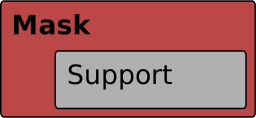
Provides a class for masks, which are a type of optical element that simply stops rays that hit it.
Also provides the function TransmitMaskRayList that returns the rays transmitted by the mask.
Created in 2021
@author: Stefan Haessler + André Kalouguine
1""" 2Provides a class for masks, which are a type of optical element that simply stops rays that hit it. 3 4Also provides the function *TransmitMaskRayList* that returns the rays transmitted by the mask. 5 6 7 8 9 10Created in 2021 11 12@author: Stefan Haessler + André Kalouguine 13""" 14# %% Modules 15import ARTcore.ModuleGeometry as mgeo 16from ARTcore.ModuleGeometry import Point, Vector, Origin 17import ARTcore.ModuleSupport as msup 18import ARTcore.ModuleOpticalRay as mray 19import ARTcore.ModuleOpticalElement as moe 20import ARTcore.ModuleMirror as mmirror 21 22import numpy as np 23from copy import copy 24import logging 25 26logger = logging.getLogger(__name__) 27 28# %%############################################################################ 29class Mask(moe.OpticalElement): 30 """ 31 A mask: a plane surface of the shape of its [Support](ModuleSupport.html), which stops all rays that hit it, 32 while all other rays continue their path unchanged. No diffraction effects. 33 34 Attributes 35 ---------- 36 support : [Support](ModuleSupport.html)-object 37 38 type : str 'Mask'. 39 40 Methods 41 ---------- 42 get_local_normal(Point) 43 44 get_centre() 45 46 get_grid3D(NbPoints) 47 48 """ 49 50 def __init__(self, Support, **kwargs): 51 """ 52 Parameters 53 ---------- 54 Support : [Support](ModuleSupport.html)-object 55 """ 56 self.type = "Mask" 57 self.support = Support 58 self.curvature = mmirror.Curvature.FLAT 59 60 self.r0 = mgeo.Point([0.0, 0.0, 0.0]) 61 self._r = mgeo.Vector([0.0, 0.0, 0.0]) 62 self._q = np.quaternion(1) 63 64 self.centre_ref = mgeo.Point([0, 0, 0]) 65 66 self.support_normal_ref = mgeo.Vector([0, 0, 1]) 67 self.normal_ref = mgeo.Vector([0, 0, 1]) 68 self.majoraxis_ref = mgeo.Vector([1, 0, 0]) 69 70 self.add_global_vectors("support_normal", "normal", "majoraxis") 71 self.add_global_points("centre") 72 73 super().__init__() 74 75 def _get_intersection(self, Ray): 76 """ 77 Return the intersection point between Ray and the xy-plane. 78 If not in alignment mode, any intersection point that is on the support is blocked. 79 """ 80 t = -Ray.point[2] / Ray.vector[2] 81 I = mgeo.Point(Ray.point +Ray.vector * t) 82 return I, I in self.support 83 84 def _get_intersections(self, RayList): 85 """ 86 Return the intersection point between Ray and the xy-plane. 87 If not in alignment mode, any intersection point that is on the support is blocked. 88 """ 89 vector = mgeo.VectorArray([ray.vector for ray in RayList]) 90 point = mgeo.PointArray([ray.point for ray in RayList]) 91 t = -point[:, 2] / vector[:, 2] 92 I = mgeo.PointArray(point + vector * t[:, np.newaxis]) 93 return I, [not(i in self.support) for i in I] 94 95 def get_local_normal(self, Point): 96 """Return normal unit vector in point 'Point' on the mask.""" 97 return np.array([0, 0, 1]) 98 99 def _zfunc(self, PointArray): 100 """Return the z-values of the plane surface at the points in PointArray.""" 101 return np.zeros(len(PointArray)) 102 103 def propagate_raylist(self, RayList, alignment=False): 104 """ 105 Propagate a list of rays through the mask, returning the transmitted rays. 106 107 Parameters 108 ---------- 109 RayList : list 110 List of Ray objects to be propagated through the mask. 111 alignment : bool, optional 112 If True, the alignment of the mask is considered. Default is False. 113 114 Returns 115 ------- 116 list 117 List of transmitted Ray objects. 118 """ 119 transmitted_rays = [] 120 local_rays = [ray.to_basis(*self.basis) for ray in RayList] 121 intersection_points, OK = self._get_intersections(local_rays) 122 N = len(RayList) 123 for i in range(N): 124 # Then we find the intersection point in the mirror reference frame 125 intersection_point = intersection_points[i] 126 local_ray = local_rays[i] 127 if OK[i]: 128 local_transmittedray = copy(local_ray) 129 local_transmittedray.point = intersection_point 130 local_transmittedray.vector = local_ray.vector 131 local_transmittedray.incidence = mgeo.AngleBetweenTwoVectors(-local_ray.vector, self.normal_ref) 132 local_transmittedray.path = local_ray.path + (np.linalg.norm(intersection_point - local_ray.point),) 133 transmitted_rays.append(local_transmittedray.from_basis(*self.basis)) 134 if len(transmitted_rays) == 0: 135 logger.warning("No rays were transmitted by the mask.") 136 logger.debug(f"Mask: {self}") 137 logger.debug(f"First ray: {RayList[0]}") 138 logger.debug(f"First ray in mask reference frame: {RayList[0].to_basis(self.r0, self.r, self.q)}") 139 logger.debug(f"First ray intersection point: {self._get_intersection(RayList[0].to_basis(self.r0, self.r, self.q))}") 140 return mray.RayList.from_list(transmitted_rays) 141 142 143# %%############################################################################ 144def _TransmitMaskRay(Mask, PointMask, Ray): 145 """Returns the transmitted ray""" 146 PointRay = Ray.point 147 VectorRay = Ray.vector 148 NormalMask = Mask.get_local_normal(PointMask) 149 150 AngleIncidence = mgeo.AngleBetweenTwoVectors(VectorRay, NormalMask) 151 Path = Ray.path + (np.linalg.norm(PointMask - PointRay),) 152 153 RayTransmitted = Ray.copy_ray() 154 RayTransmitted.point = PointMask 155 RayTransmitted.vector = VectorRay 156 RayTransmitted.incidence = AngleIncidence 157 RayTransmitted.path = Path 158 159 return RayTransmitted 160 161 162# %% 163def TransmitMaskRayList(Mask, RayList): 164 """ 165 Returns the the transmitted rays that pass the mask for the list of 166 incident rays ListRay. 167 168 Rays that hit the support are not further propagated. 169 170 Updates the reflected rays' incidence angle and path. 171 172 Parameters 173 ---------- 174 Mask : Mask-object 175 176 ListRay : list[Ray-object] 177 178 """ 179 ListRayTransmitted = [] 180 for Ray in RayList: 181 PointMask = Mask._get_intersection(Ray) 182 183 if PointMask is not None: 184 RayTransmitted = _TransmitMaskRay(Mask, PointMask, Ray) 185 ListRayTransmitted.append(RayTransmitted) 186 187 return ListRayTransmitted
 30class Mask(moe.OpticalElement):
 31    """
 32    A mask: a plane surface of the shape of its [Support](ModuleSupport.html), which stops all rays that hit it,
 33    while all other rays continue their path unchanged. No diffraction effects.
 34
 35    Attributes
 36    ----------
 37        support : [Support](ModuleSupport.html)-object
 38
 39        type : str 'Mask'.
 40
 41    Methods
 42    ----------
 43        get_local_normal(Point)
 44
 45        get_centre()
 46
 47        get_grid3D(NbPoints)
 48
 49    """
 50
 51    def __init__(self, Support, **kwargs):
 52        """
 53        Parameters
 54        ----------
 55            Support : [Support](ModuleSupport.html)-object
 56        """
 57        self.type = "Mask"
 58        self.support = Support
 59        self.curvature = mmirror.Curvature.FLAT
 60
 61        self.r0 = mgeo.Point([0.0, 0.0, 0.0])
 62        self._r = mgeo.Vector([0.0, 0.0, 0.0])
 63        self._q = np.quaternion(1)
 64
 65        self.centre_ref = mgeo.Point([0, 0, 0])
 66
 67        self.support_normal_ref = mgeo.Vector([0, 0, 1])
 68        self.normal_ref = mgeo.Vector([0, 0, 1])
 69        self.majoraxis_ref = mgeo.Vector([1, 0, 0])
 70
 71        self.add_global_vectors("support_normal", "normal", "majoraxis")
 72        self.add_global_points("centre")
 73
 74        super().__init__()
 75
 76    def _get_intersection(self, Ray):
 77        """
 78        Return the intersection point between Ray and the xy-plane.
 79        If not in alignment mode, any intersection point that is on the support is blocked.
 80        """
 81        t = -Ray.point[2] / Ray.vector[2]
 82        I = mgeo.Point(Ray.point +Ray.vector * t)
 83        return I, I in self.support
 84
 85    def _get_intersections(self, RayList):
 86        """
 87        Return the intersection point between Ray and the xy-plane.
 88        If not in alignment mode, any intersection point that is on the support is blocked.
 89        """
 90        vector = mgeo.VectorArray([ray.vector for ray in RayList])
 91        point = mgeo.PointArray([ray.point for ray in RayList])
 92        t = -point[:, 2] / vector[:, 2]
 93        I = mgeo.PointArray(point + vector * t[:, np.newaxis])
 94        return I, [not(i in self.support) for i in I]
 95
 96    def get_local_normal(self, Point):
 97        """Return normal unit vector in point 'Point' on the mask."""
 98        return np.array([0, 0, 1])
 99
100    def _zfunc(self, PointArray):
101        """Return the z-values of the plane surface at the points in PointArray."""
102        return np.zeros(len(PointArray))
103
104    def propagate_raylist(self, RayList, alignment=False):
105        """
106        Propagate a list of rays through the mask, returning the transmitted rays.
107
108        Parameters
109        ----------
110        RayList : list
111            List of Ray objects to be propagated through the mask.
112        alignment : bool, optional
113            If True, the alignment of the mask is considered. Default is False.
114
115        Returns
116        -------
117        list
118            List of transmitted Ray objects.
119        """
120        transmitted_rays = []
121        local_rays = [ray.to_basis(*self.basis) for ray in RayList]
122        intersection_points, OK = self._get_intersections(local_rays)
123        N = len(RayList)
124        for i in range(N):
125            # Then we find the intersection point in the mirror reference frame
126            intersection_point = intersection_points[i]
127            local_ray = local_rays[i]
128            if OK[i]:
129                local_transmittedray = copy(local_ray)
130                local_transmittedray.point = intersection_point
131                local_transmittedray.vector = local_ray.vector
132                local_transmittedray.incidence = mgeo.AngleBetweenTwoVectors(-local_ray.vector, self.normal_ref)
133                local_transmittedray.path = local_ray.path + (np.linalg.norm(intersection_point - local_ray.point),)
134                transmitted_rays.append(local_transmittedray.from_basis(*self.basis))
135        if len(transmitted_rays) == 0:
136            logger.warning("No rays were transmitted by the mask.")
137            logger.debug(f"Mask: {self}")
138            logger.debug(f"First ray: {RayList[0]}")
139            logger.debug(f"First ray in mask reference frame: {RayList[0].to_basis(self.r0, self.r, self.q)}")
140            logger.debug(f"First ray intersection point: {self._get_intersection(RayList[0].to_basis(self.r0, self.r, self.q))}")
141        return mray.RayList.from_list(transmitted_rays)
A mask: a plane surface of the shape of its Support, which stops all rays that hit it, while all other rays continue their path unchanged. No diffraction effects.
Attributes
support : [Support](ModuleSupport.html)-object

type : str 'Mask'.
Methods
get_local_normal(Point)

get_centre()

get_grid3D(NbPoints)
51    def __init__(self, Support, **kwargs):
52        """
53        Parameters
54        ----------
55            Support : [Support](ModuleSupport.html)-object
56        """
57        self.type = "Mask"
58        self.support = Support
59        self.curvature = mmirror.Curvature.FLAT
60
61        self.r0 = mgeo.Point([0.0, 0.0, 0.0])
62        self._r = mgeo.Vector([0.0, 0.0, 0.0])
63        self._q = np.quaternion(1)
64
65        self.centre_ref = mgeo.Point([0, 0, 0])
66
67        self.support_normal_ref = mgeo.Vector([0, 0, 1])
68        self.normal_ref = mgeo.Vector([0, 0, 1])
69        self.majoraxis_ref = mgeo.Vector([1, 0, 0])
70
71        self.add_global_vectors("support_normal", "normal", "majoraxis")
72        self.add_global_points("centre")
73
74        super().__init__()
Parameters
Support : [Support](ModuleSupport.html)-object
96    def get_local_normal(self, Point):
97        """Return normal unit vector in point 'Point' on the mask."""
98        return np.array([0, 0, 1])
Return normal unit vector in point 'Point' on the mask.
104    def propagate_raylist(self, RayList, alignment=False):
105        """
106        Propagate a list of rays through the mask, returning the transmitted rays.
107
108        Parameters
109        ----------
110        RayList : list
111            List of Ray objects to be propagated through the mask.
112        alignment : bool, optional
113            If True, the alignment of the mask is considered. Default is False.
114
115        Returns
116        -------
117        list
118            List of transmitted Ray objects.
119        """
120        transmitted_rays = []
121        local_rays = [ray.to_basis(*self.basis) for ray in RayList]
122        intersection_points, OK = self._get_intersections(local_rays)
123        N = len(RayList)
124        for i in range(N):
125            # Then we find the intersection point in the mirror reference frame
126            intersection_point = intersection_points[i]
127            local_ray = local_rays[i]
128            if OK[i]:
129                local_transmittedray = copy(local_ray)
130                local_transmittedray.point = intersection_point
131                local_transmittedray.vector = local_ray.vector
132                local_transmittedray.incidence = mgeo.AngleBetweenTwoVectors(-local_ray.vector, self.normal_ref)
133                local_transmittedray.path = local_ray.path + (np.linalg.norm(intersection_point - local_ray.point),)
134                transmitted_rays.append(local_transmittedray.from_basis(*self.basis))
135        if len(transmitted_rays) == 0:
136            logger.warning("No rays were transmitted by the mask.")
137            logger.debug(f"Mask: {self}")
138            logger.debug(f"First ray: {RayList[0]}")
139            logger.debug(f"First ray in mask reference frame: {RayList[0].to_basis(self.r0, self.r, self.q)}")
140            logger.debug(f"First ray intersection point: {self._get_intersection(RayList[0].to_basis(self.r0, self.r, self.q))}")
141        return mray.RayList.from_list(transmitted_rays)
Propagate a list of rays through the mask, returning the transmitted rays.
Parameters
RayList : list List of Ray objects to be propagated through the mask. alignment : bool, optional If True, the alignment of the mask is considered. Default is False.
Returns
list List of transmitted Ray objects.
234def _RenderMirror(Mirror, Npoints=1000, draw_support = False, draw_points = False, draw_vectors = True , recenter_support = True):
235    """
236    This function renders a mirror in 3D.
237    """
238    mesh = Mirror._Render(Npoints)
239    p = pv.Plotter()
240    p.add_mesh(mesh)
241    if draw_support:
242        support = Mirror.support._Render()
243        if recenter_support:
244            support.translate(Mirror.r0,inplace=True)
245        p.add_mesh(support, color="gray", opacity=0.5)
246
247    if draw_vectors:
248        # We draw the important vectors of the optical element
249        # For that, if we have a "vectors" attribute, we use that
250        #  (a dictionary with the vector names as keys and the colors as values)
251        # Otherwise we use the default vectors: "support_normal", "majoraxis"
252        if hasattr(Mirror, "vectors"):
253            vectors = Mirror.vectors
254        else:
255            vectors = {"support_normal_ref": "red", "majoraxis_ref": "blue"}
256        for vector, color in vectors.items():
257            if hasattr(Mirror, vector):
258                p.add_arrows(Mirror.r0, 10*getattr(Mirror, vector), color=color)
259
260    if draw_points:
261        # We draw the important points of the optical element
262        # For that, if we have a "points" attribute, we use that
263        #  (a dictionary with the point names as keys and the colors as values)
264        # Otherwise we use the default points: "centre_ref"
265        if hasattr(Mirror, "points"):
266            points = Mirror.points
267        else:
268            points = {"centre_ref": "red"}
269        for point, color in points.items():
270            if hasattr(Mirror, point):
271                p.add_mesh(pv.Sphere(radius=1, center=getattr(Mirror, point)), color=color)
272    else:
273        p.add_mesh(pv.Sphere(radius=1, center=Mirror.r0), color="red")
274    p.show()
275    return p
This function renders a mirror in 3D.
164def TransmitMaskRayList(Mask, RayList):
165    """
166    Returns the the transmitted rays that pass the mask for the list of
167    incident rays ListRay.
168
169    Rays that hit the support are not further propagated.
170
171    Updates the reflected rays' incidence angle and path.
172
173    Parameters
174    ----------
175        Mask : Mask-object
176
177        ListRay : list[Ray-object]
178
179    """
180    ListRayTransmitted = []
181    for Ray in RayList:
182        PointMask = Mask._get_intersection(Ray)
183
184        if PointMask is not None:
185            RayTransmitted = _TransmitMaskRay(Mask, PointMask, Ray)
186            ListRayTransmitted.append(RayTransmitted)
187
188    return ListRayTransmitted
Returns the the transmitted rays that pass the mask for the list of incident rays ListRay.
Rays that hit the support are not further propagated.
Updates the reflected rays' incidence angle and path.
Parameters
Mask : Mask-object

ListRay : list[Ray-object]