ModuleDetector
Provides a class which represents a virtual detector —a plane in 3D space— with methods to analyze the impact points of a ray bundle intercepting it.
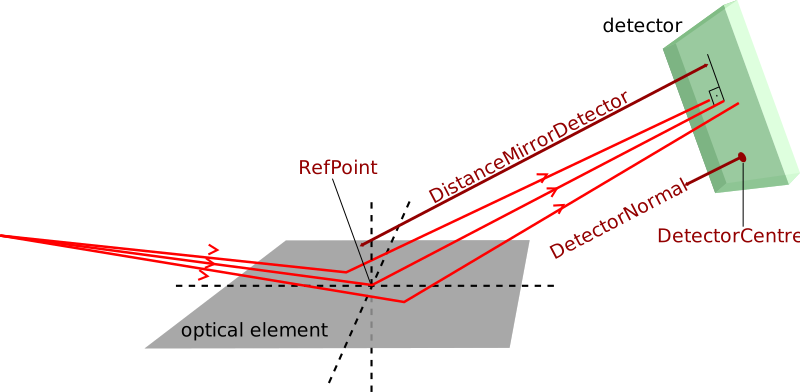
Created in Sept 2020
@author: Stefan Haessler + André Kalouguine
1""" 2Provides a class which represents a virtual detector —a plane in 3D space— with methods 3to analyze the impact points of a ray bundle intercepting it. 4 5 6 7 8 9Created in Sept 2020 10 11@author: Stefan Haessler + André Kalouguine 12""" 13# %% Modules 14 15import numpy as np 16import quaternion 17from abc import ABC, abstractmethod 18 19import ARTcore.ModuleProcessing as mp 20import ARTcore.ModuleOpticalRay as mray 21import ARTcore.ModuleGeometry as mgeo 22from ARTcore.ModuleGeometry import Point, Vector, Origin 23 24# This is to allow multiple constructors based on the type of the first argument 25from functools import singledispatchmethod 26import logging 27from copy import copy 28import time 29 30 31logger = logging.getLogger(__name__) 32 33LightSpeed = 299792458000 34 35# %% Abstract class 36class Detector(ABC): 37 """ 38 Abstract class describing a detector and the properties/methods it has to have. 39 It implements the required components for the detector to behave as a 3D object. 40 Non-abstract subclasses of `Detector` should implement the remaining 41 functiuons such as the detection of rays 42 """ 43 type = "Generic Detector (Abstract)" 44 @property 45 def r(self): 46 """ 47 Return the offset of the optical element from its reference frame to the lab reference frame. 48 Not that this is **NOT** the position of the optical element's center point. Rather it is the 49 offset of the reference frame of the optical element from the lab reference frame. 50 """ 51 return self._r 52 53 @r.setter 54 def r(self, NewPosition): 55 """ 56 Set the offset of the optical element from its reference frame to the lab reference frame. 57 """ 58 if isinstance(NewPosition, mgeo.Point) and len(NewPosition) == 3: 59 self._r = NewPosition 60 else: 61 raise TypeError("Position must be a 3D mgeo.Point.") 62 @property 63 def q(self): 64 """ 65 Return the orientation of the optical element. 66 The orientation is stored as a unit quaternion representing the rotation from the optic's coordinate frame to the lab frame. 67 """ 68 return self._q 69 70 @q.setter 71 def q(self, NewOrientation): 72 """ 73 Set the orientation of the optical element. 74 This function normalizes the input quaternion before storing it. 75 If the input is not a quaternion, raise a TypeError. 76 """ 77 if isinstance(NewOrientation, np.quaternion): 78 self._q = NewOrientation.normalized() 79 else: 80 raise TypeError("Orientation must be a quaternion.") 81 82 @property 83 def position(self): 84 """ 85 Return the position of the basepoint of the optical element. Often it is the same as the optical centre. 86 This position is the one around which all rotations are performed. 87 """ 88 return self.r0 + self.r 89 90 @property 91 def orientation(self): 92 """ 93 Return the orientation of the optical element. 94 The utility of this method is unclear. 95 """ 96 return self.q 97 98 @property 99 def basis(self): 100 return self.r0, self.r, self.q 101 102 def __init__(self): 103 self._r = mgeo.Vector([0.0, 0.0, 0.0]) 104 self._q = np.quaternion(1, 0, 0, 0) 105 self.r0 = mgeo.Point([0.0, 0.0, 0.0]) 106 107 @abstractmethod 108 def centre(self): 109 """ 110 (0,0) point of the detector. 111 """ 112 pass 113 114 @abstractmethod 115 def refpoint(self): 116 """ 117 Reference point from which to measure the distance of the detector. 118 Usually the center of the previous optical element. 119 """ 120 pass 121 122 @property 123 def distance(self): 124 """ 125 Return distance of the Detector from its reference point Detector.refpoint. 126 """ 127 return (self.refpoint - self.centre).norm 128 129 @distance.setter 130 def distance(self, NewDistance: float): 131 """ 132 Shift the Detector to the distance NewDistance from its reference point Detector.refpoint. 133 134 Parameters 135 ---------- 136 NewDistance : number 137 The distance (absolute) to which to shift the Detector. 138 """ 139 vector = (self.centre - self.refpoint).normalized 140 self.centre = self.refpoint + vector * NewDistance 141 142 @abstractmethod 143 def get_2D_points(self, RayList): 144 pass 145 146 @abstractmethod 147 def get_3D_points(self, RayList): 148 pass 149 150 @abstractmethod 151 def __copy__(self): 152 pass 153 154 155# %% Infinite plane detector class 156class InfiniteDetector(Detector): 157 """ 158 Simple infinite plane. 159 Beyond being just a solid object, the 160 161 Attributes 162 ---------- 163 centre : np.ndarray 164 3D Point in the Detector plane. 165 166 refpoint : np.ndarray 167 3D reference point from which to measure the Detector distance. 168 """ 169 type = "Infinite Detector" 170 def __init__(self, index=-1): 171 super().__init__() 172 self._centre = mgeo.Origin 173 self._refpoint = mgeo.Origin 174 self.index = index 175 176 def __copy__(self): 177 """ 178 Returns a new Detector object with the same properties. 179 """ 180 result = InfiniteDetector() 181 result._centre = copy(self._centre) 182 result._refpoint = copy(self._refpoint) 183 result._r = copy(self._r) 184 result._q = copy(self._q) 185 result.r0 = copy(self.r0) 186 result.index = self.index 187 return result 188 189 @property 190 def normal(self): 191 return mgeo.Vector([0,0,1]).from_basis(*self.basis) 192 193 @property 194 def centre(self): 195 return self._centre 196 197 # a setter function 198 @centre.setter 199 def centre(self, Centre): 200 if isinstance(Centre, np.ndarray) and Centre.shape == (3,): 201 self._centre = mgeo.Point(Centre) 202 self.r = self._centre # Simply because r0 is 0,0,0 anyways 203 else: 204 raise TypeError("Detector Centre must be a 3D-vector, given as numpy.ndarray of shape (3,).") 205 206 @property 207 def refpoint(self): 208 return self._refpoint 209 210 # a setter function 211 @refpoint.setter 212 def refpoint(self, RefPoint): 213 if isinstance(RefPoint, np.ndarray) and RefPoint.shape == (3,): 214 self._refpoint = mgeo.Point(RefPoint) 215 else: 216 raise TypeError("Detector RefPoint must a 3D-Point") 217 218 # %% Detector placement methods 219 220 @property 221 def distance(self): 222 """ 223 Return distance of the Detector from its reference point Detector.refpoint. 224 """ 225 return (self.refpoint - self.centre).norm 226 227 @distance.setter 228 def distance(self, NewDistance: float): 229 """ 230 Shift the Detector to the distance NewDistance from its reference point Detector.refpoint. 231 232 Parameters 233 ---------- 234 NewDistance : number 235 The distance (absolute) to which to shift the Detector. 236 """ 237 vector = (self.centre - self.refpoint).normalized() 238 self.centre = self.refpoint + vector * NewDistance 239 240 def set_distance(self,x): 241 self.distance = x 242 243 def autoplace(self, RayList, DistanceDetector: float): 244 """ 245 Automatically place and orient the detector such that it is normal to the central ray 246 of the supplied RayList, at the distance DistanceDetector the origin point of that central ray. 247 248 Parameters 249 ---------- 250 RayList : list[Ray] 251 A list of objects of the ModuleOpticalRay.Ray-class. 252 253 DistanceDetector : float 254 The distance at which to place the Detector. 255 """ 256 #CentralRay = mp.FindCentralRay(RayList) 257 CentralRay = RayList[0] 258 if CentralRay is None: 259 logger.warning(f"Could not find central ray! The list of rays has a length of {len(RayList)}") 260 CentralPoint = mgeo.Origin 261 for k in RayList: 262 CentralPoint = CentralPoint + (k.point - mgeo.Origin) 263 CentralPoint = CentralPoint / len(RayList) 264 else: 265 logger.debug(f"Found central ray, using it to position detector: \n{CentralRay}") 266 CentralPoint = CentralRay.point 267 268 self.centre = CentralPoint + CentralRay.vector * DistanceDetector 269 self.refpoint = CentralPoint 270 self.q = mgeo.QRotationVector2Vector(mgeo.Vector([0,0,1]), -CentralRay.vector) 271 272 # %% Detector optimisation methods 273 def test_callback_distances(self, RayList, distances, callback, 274 provide_points=False, 275 detector_reference_frame=False): 276 LocalRayList = [k.to_basis(*self.basis) for k in RayList] 277 N = len(distances) 278 # Calculate the impact points 279 Points = mgeo.IntersectionRayListZPlane(LocalRayList, distances) 280 values = [] 281 for k in range(N): 282 Points[k] = Points[k]._add_dimension() + mgeo.Point([0,0,distances[k]]) 283 values += [callback(RayList, Points[k], self.basis)] 284 return values 285 286 def optimise_distance(self, RayList, Range, callback, 287 detector_reference_frame=False, 288 provide_points=False, 289 maxiter=5, 290 tol=1e-6, 291 splitting=50, 292 Nrays=1000, 293 callback_iteration=None 294 ): 295 """ 296 Optimise the position of the detector within the provided range, trying to 297 maximise some value calculated by the callback function. 298 299 The callback function receives a list of rays that already hit the detector. 300 If requested, the rays can be provided in the reference frame of the detector. 301 302 The callback function should return a single value that is to be minimised. 303 304 The function splits the range into `splitting` points and uses the `IntersectionRayListZPlane` 305 function to calculate the impact points for all of these. 306 If `provide_points` is set to True, the function will pass on the result to the callback function. 307 Otherwise it will generate rays for the callback function, including calculating the paths. 308 309 It will then find the best value and redo the iteration around that value. 310 Repeat until either the maximum number of iterations is reached or the tolerance is met. 311 312 Parameters 313 ---------- 314 RayList : list[Ray] 315 A list of objects of the ModuleOpticalRay.Ray-class. 316 317 Range : tuple 318 The range of distances to consider for the detector placement. 319 320 callback : function 321 The function to be minimised. It should take a list of rays and return a single value. 322 323 detector_reference_frame : bool 324 If True, the rays are provided in the reference frame of the detector. 325 326 provide_points : bool 327 If True, the callback function will receive the impact points directly. 328 329 maxiter : int 330 The maximum number of iterations to perform. 331 332 tol : float 333 The tolerance to reach before stopping the iteration. 334 335 splitting : int 336 The number of points to split the range into. 337 338 Returns 339 ---------- 340 The optimal distance of the detector. 341 """ 342 Range = [i-self.distance for i in Range] 343 if Nrays<len(RayList): 344 RayList = np.random.choice(RayList, Nrays, replace=False) 345 previous_best = None 346 values = [0]*splitting 347 for i in range(maxiter): 348 if callback_iteration is not None: 349 callback_iteration(i, Range) 350 # Split the range into `splitting` points 351 distances = np.linspace(*Range, splitting) 352 values = self.test_callback_distances(RayList, distances, callback, 353 provide_points=provide_points, 354 detector_reference_frame=detector_reference_frame) 355 best = np.argmin(values) 356 # Update the range 357 if best == 0: 358 Range = (distances[0], distances[2]) 359 elif best == splitting - 1: 360 Range = (distances[-3], distances[-1]) 361 else: 362 Range = (distances[best - 1], distances[best + 1]) 363 # Check if the tolerance is met 364 if i>0: 365 if np.abs(values[best] - previous_best) < tol: 366 break 367 previous_best = values[best] 368 self.distance -= distances[best] 369 370 def _spot_size(self, RayList, Points, basis): 371 """ 372 Returns focal spot size. 373 374 Parameters 375 ---------- 376 Points : mgeo.PointArray 377 The points where the rays hit the detector. 378 Returns 379 ---------- 380 float 381 """ 382 center = mgeo.Point(np.mean(Points[:,:2], axis=0)) 383 distances = (Points[:,:2] - center).norm 384 return np.std(distances) 385 386 def _delay_std(self, RayList, Points, basis): 387 """ 388 Returns the standard deviation of the delays of the rays 389 390 Parameters 391 ---------- 392 RayList : list[Ray] 393 A list of objects of the ModuleOpticalRay.Ray-class. 394 395 Returns 396 ---------- 397 float 398 """ 399 #paths = np.array([np.sum(k.path) for k in RayList]) 400 paths = np.sum(np.array([k.path for k in RayList], dtype=float), axis=1) 401 StartingPoints = mgeo.PointArray([k.point for k in RayList]) 402 XYZ = Points.from_basis(*basis) 403 LastDistances = (XYZ - StartingPoints).norm 404 return float(np.std(paths+LastDistances)) 405 406 def _over_intensity(self, RayList, Points, Basis): 407 """ 408 Calculates spot_size * delay_std for the given RayList. 409 """ 410 spot_size = self._spot_size(RayList, Points, Basis) 411 delay_std = self._delay_std(RayList, Points, Basis) 412 return spot_size**2 * delay_std 413 414 # %% Detector response methods 415 def get_3D_points(self, RayList) -> list[np.ndarray]: 416 """ 417 Returns the list of 3D-points in lab-space where the rays in the 418 list RayList hit the detector plane. 419 420 Parameters 421 ---------- 422 RayList : list[Ray] 423 A list of objects of the ModuleOpticalRay.Ray-class. 424 425 Returns 426 ---------- 427 ListPointDetector3D : list[np.ndarray of shape (3,)] 428 """ 429 return self.get_2D_points(RayList)[0]._add_dimension().from_basis(*self.basis) 430 431 def get_2D_points(self, RayList) -> list[np.ndarray]: 432 """ 433 Returns the list of 2D-points in the detector plane, with the origin at Detector.centre. 434 435 Parameters 436 ---------- 437 RayList : list[Ray] 438 A list of objects of the ModuleOpticalRay.Ray-class of length N 439 440 Returns 441 ---------- 442 XY : np.ndarray of shape (N,2) 443 """ 444 return mgeo.IntersectionRayListZPlane([r.to_basis(*self.basis) for r in RayList]) 445 446 def get_centre_2D_points(self, RayList) -> list[np.ndarray]: 447 """ 448 Returns the center of the 2D array of points. 449 450 Parameters 451 ---------- 452 RayList* : list[Ray] 453 A list of objects of the ModuleOpticalRay.Ray-class. 454 455 Returns 456 ---------- 457 ListPointDetector2DCentre : list[np.ndarray of shape (2,)] 458 """ 459 return np.mean(self.get_2D_points(RayList), axis=0) 460 461 def get_Delays(self, RayList) -> list[float]: 462 """ 463 Returns the list of delays of the rays of RayList as they hit the detector plane, 464 calculated as their total path length divided by the speed of light. 465 The delays are relative to the mean “travel time”, i.e. the mean path length of RayList 466 divided by the speed of light. 467 The list index corresponds to that of the RayList. 468 469 Parameters 470 ---------- 471 RayList : list[Ray] 472 A list of objects of the ModuleOpticalRay.Ray-class. 473 474 Returns 475 ---------- 476 DelayList : list[float] 477 """ 478 localRayList = RayList.to_basis(*self.basis) 479 paths = np.sum(RayList.path, axis=1) 480 StartingPoints = mgeo.PointArray([k.point for k in localRayList]) 481 XYZ = mgeo.IntersectionRayListZPlane(localRayList)[0]._add_dimension() 482 LastDistances = (XYZ - StartingPoints).norm 483 TotalPaths = paths+LastDistances 484 MeanPath = np.mean(TotalPaths) 485 return list((TotalPaths-MeanPath) / LightSpeed * 1e15) # in fs
 37class Detector(ABC):
 38    """
 39    Abstract class describing a detector and the properties/methods it has to have.
 40    It implements the required components for the detector to behave as a 3D object.
 41    Non-abstract subclasses of `Detector` should implement the remaining
 42    functiuons such as the detection of rays
 43    """
 44    type = "Generic Detector (Abstract)"
 45    @property
 46    def r(self):
 47        """
 48        Return the offset of the optical element from its reference frame to the lab reference frame.
 49        Not that this is **NOT** the position of the optical element's center point. Rather it is the
 50        offset of the reference frame of the optical element from the lab reference frame.
 51        """
 52        return self._r
 53
 54    @r.setter
 55    def r(self, NewPosition):
 56        """
 57        Set the offset of the optical element from its reference frame to the lab reference frame.
 58        """
 59        if isinstance(NewPosition, mgeo.Point) and len(NewPosition) == 3:
 60            self._r = NewPosition
 61        else:
 62            raise TypeError("Position must be a 3D mgeo.Point.")
 63    @property
 64    def q(self):
 65        """
 66        Return the orientation of the optical element.
 67        The orientation is stored as a unit quaternion representing the rotation from the optic's coordinate frame to the lab frame.
 68        """
 69        return self._q
 70
 71    @q.setter
 72    def q(self, NewOrientation):
 73        """
 74        Set the orientation of the optical element.
 75        This function normalizes the input quaternion before storing it.
 76        If the input is not a quaternion, raise a TypeError.
 77        """
 78        if isinstance(NewOrientation, np.quaternion):
 79            self._q = NewOrientation.normalized()
 80        else:
 81            raise TypeError("Orientation must be a quaternion.")
 82
 83    @property
 84    def position(self):
 85        """
 86        Return the position of the basepoint of the optical element. Often it is the same as the optical centre.
 87        This position is the one around which all rotations are performed.
 88        """
 89        return self.r0 + self.r
 90
 91    @property
 92    def orientation(self):
 93        """
 94        Return the orientation of the optical element.
 95        The utility of this method is unclear.
 96        """
 97        return self.q
 98
 99    @property
100    def basis(self):
101        return self.r0, self.r, self.q
102
103    def __init__(self):
104        self._r = mgeo.Vector([0.0, 0.0, 0.0])
105        self._q = np.quaternion(1, 0, 0, 0)
106        self.r0 = mgeo.Point([0.0, 0.0, 0.0])
107
108    @abstractmethod
109    def centre(self):
110        """
111        (0,0) point of the detector.
112        """
113        pass
114
115    @abstractmethod
116    def refpoint(self):
117        """
118        Reference point from which to measure the distance of the detector.
119        Usually the center of the previous optical element.
120        """
121        pass
122
123    @property
124    def distance(self):
125        """
126        Return distance of the Detector from its reference point Detector.refpoint.
127        """
128        return (self.refpoint - self.centre).norm
129
130    @distance.setter
131    def distance(self, NewDistance: float):
132        """
133        Shift the Detector to the distance NewDistance from its reference point Detector.refpoint.
134
135        Parameters
136        ----------
137            NewDistance : number
138                The distance (absolute) to which to shift the Detector.
139        """
140        vector = (self.centre - self.refpoint).normalized
141        self.centre = self.refpoint + vector * NewDistance
142
143    @abstractmethod
144    def get_2D_points(self, RayList):
145        pass
146
147    @abstractmethod
148    def get_3D_points(self, RayList):
149        pass
150
151    @abstractmethod
152    def __copy__(self):
153        pass
Abstract class describing a detector and the properties/methods it has to have.
It implements the required components for the detector to behave as a 3D object.
Non-abstract subclasses of Detector should implement the remaining
functiuons such as the detection of rays
45    @property
46    def r(self):
47        """
48        Return the offset of the optical element from its reference frame to the lab reference frame.
49        Not that this is **NOT** the position of the optical element's center point. Rather it is the
50        offset of the reference frame of the optical element from the lab reference frame.
51        """
52        return self._r
Return the offset of the optical element from its reference frame to the lab reference frame. Not that this is NOT the position of the optical element's center point. Rather it is the offset of the reference frame of the optical element from the lab reference frame.
63    @property
64    def q(self):
65        """
66        Return the orientation of the optical element.
67        The orientation is stored as a unit quaternion representing the rotation from the optic's coordinate frame to the lab frame.
68        """
69        return self._q
Return the orientation of the optical element. The orientation is stored as a unit quaternion representing the rotation from the optic's coordinate frame to the lab frame.
83    @property
84    def position(self):
85        """
86        Return the position of the basepoint of the optical element. Often it is the same as the optical centre.
87        This position is the one around which all rotations are performed.
88        """
89        return self.r0 + self.r
Return the position of the basepoint of the optical element. Often it is the same as the optical centre. This position is the one around which all rotations are performed.
91    @property
92    def orientation(self):
93        """
94        Return the orientation of the optical element.
95        The utility of this method is unclear.
96        """
97        return self.q
Return the orientation of the optical element. The utility of this method is unclear.
115    @abstractmethod
116    def refpoint(self):
117        """
118        Reference point from which to measure the distance of the detector.
119        Usually the center of the previous optical element.
120        """
121        pass
Reference point from which to measure the distance of the detector. Usually the center of the previous optical element.
123    @property
124    def distance(self):
125        """
126        Return distance of the Detector from its reference point Detector.refpoint.
127        """
128        return (self.refpoint - self.centre).norm
Return distance of the Detector from its reference point Detector.refpoint.
157class InfiniteDetector(Detector):
158    """
159    Simple infinite plane.
160    Beyond being just a solid object, the
161
162    Attributes
163    ----------
164        centre : np.ndarray
165            3D Point in the Detector plane.
166
167        refpoint : np.ndarray
168            3D reference point from which to measure the Detector distance.
169    """
170    type = "Infinite Detector"
171    def __init__(self, index=-1):
172        super().__init__()
173        self._centre = mgeo.Origin
174        self._refpoint = mgeo.Origin
175        self.index = index
176
177    def __copy__(self):
178        """
179        Returns a new Detector object with the same properties.
180        """
181        result = InfiniteDetector()
182        result._centre = copy(self._centre)
183        result._refpoint = copy(self._refpoint)
184        result._r = copy(self._r)
185        result._q = copy(self._q)
186        result.r0 = copy(self.r0)
187        result.index = self.index
188        return result
189
190    @property
191    def normal(self):
192        return mgeo.Vector([0,0,1]).from_basis(*self.basis)
193
194    @property
195    def centre(self):
196        return self._centre
197
198    # a setter function
199    @centre.setter
200    def centre(self, Centre):
201        if isinstance(Centre, np.ndarray) and Centre.shape == (3,):
202            self._centre = mgeo.Point(Centre)
203            self.r = self._centre # Simply because r0 is 0,0,0 anyways
204        else:
205            raise TypeError("Detector Centre must be a 3D-vector, given as numpy.ndarray of shape (3,).")
206
207    @property
208    def refpoint(self):
209        return self._refpoint
210
211    # a setter function
212    @refpoint.setter
213    def refpoint(self, RefPoint):
214        if isinstance(RefPoint, np.ndarray) and RefPoint.shape == (3,):
215            self._refpoint = mgeo.Point(RefPoint)
216        else:
217            raise TypeError("Detector RefPoint must a 3D-Point")
218
219    # %% Detector placement methods
220
221    @property
222    def distance(self):
223        """
224        Return distance of the Detector from its reference point Detector.refpoint.
225        """
226        return (self.refpoint - self.centre).norm
227
228    @distance.setter
229    def distance(self, NewDistance: float):
230        """
231        Shift the Detector to the distance NewDistance from its reference point Detector.refpoint.
232
233        Parameters
234        ----------
235            NewDistance : number
236                The distance (absolute) to which to shift the Detector.
237        """
238        vector = (self.centre - self.refpoint).normalized()
239        self.centre = self.refpoint + vector * NewDistance
240
241    def set_distance(self,x):
242        self.distance = x
243
244    def autoplace(self, RayList, DistanceDetector: float):
245        """
246        Automatically place and orient the detector such that it is normal to the central ray
247        of the supplied RayList, at the distance DistanceDetector the origin point of that central ray.
248
249        Parameters
250        ----------
251            RayList : list[Ray]
252                A list of objects of the ModuleOpticalRay.Ray-class.
253
254            DistanceDetector : float
255                The distance at which to place the Detector.
256        """
257        #CentralRay = mp.FindCentralRay(RayList)
258        CentralRay = RayList[0]
259        if CentralRay is None:
260            logger.warning(f"Could not find central ray! The list of rays has a length of {len(RayList)}")
261            CentralPoint = mgeo.Origin
262            for k in RayList:
263                CentralPoint = CentralPoint + (k.point - mgeo.Origin)
264            CentralPoint = CentralPoint / len(RayList)
265        else:
266            logger.debug(f"Found central ray, using it to position detector: \n{CentralRay}")
267            CentralPoint = CentralRay.point
268
269        self.centre = CentralPoint + CentralRay.vector * DistanceDetector
270        self.refpoint = CentralPoint
271        self.q = mgeo.QRotationVector2Vector(mgeo.Vector([0,0,1]), -CentralRay.vector)
272
273    # %% Detector optimisation methods
274    def test_callback_distances(self, RayList, distances, callback,
275                                provide_points=False,
276                                detector_reference_frame=False):
277        LocalRayList = [k.to_basis(*self.basis) for k in RayList]
278        N = len(distances)
279        # Calculate the impact points
280        Points = mgeo.IntersectionRayListZPlane(LocalRayList, distances)
281        values = []
282        for k in range(N):
283            Points[k] = Points[k]._add_dimension() + mgeo.Point([0,0,distances[k]])
284            values += [callback(RayList, Points[k], self.basis)]
285        return values
286
287    def optimise_distance(self, RayList, Range,  callback,
288                          detector_reference_frame=False,
289                          provide_points=False,
290                          maxiter=5,
291                          tol=1e-6,
292                          splitting=50,
293                          Nrays=1000,
294                          callback_iteration=None
295        ):
296        """
297        Optimise the position of the detector within the provided range, trying to
298        maximise some value calculated by the callback function.
299
300        The callback function receives a list of rays that already hit the detector.
301        If requested, the rays can be provided in the reference frame of the detector.
302
303        The callback function should return a single value that is to be minimised.
304
305        The function splits the range into `splitting` points and uses the `IntersectionRayListZPlane`
306        function to calculate the impact points for all of these.
307        If `provide_points` is set to True, the function will pass on the result to the callback function.
308        Otherwise it will generate rays for the callback function, including calculating the paths.
309
310        It will then find the best value and redo the iteration around that value.
311        Repeat until either the maximum number of iterations is reached or the tolerance is met.
312
313        Parameters
314        ----------
315            RayList : list[Ray]
316                A list of objects of the ModuleOpticalRay.Ray-class.
317
318            Range : tuple
319                The range of distances to consider for the detector placement.
320
321            callback : function
322                The function to be minimised. It should take a list of rays and return a single value.
323
324            detector_reference_frame : bool
325                If True, the rays are provided in the reference frame of the detector.
326
327            provide_points : bool
328                If True, the callback function will receive the impact points directly.
329
330            maxiter : int
331                The maximum number of iterations to perform.
332
333            tol : float
334                The tolerance to reach before stopping the iteration.
335
336            splitting : int
337                The number of points to split the range into.
338
339        Returns
340        ----------
341            The optimal distance of the detector.
342        """
343        Range = [i-self.distance for i in Range]
344        if Nrays<len(RayList):
345            RayList = np.random.choice(RayList, Nrays, replace=False)
346        previous_best = None
347        values = [0]*splitting
348        for i in range(maxiter):
349            if callback_iteration is not None:
350                callback_iteration(i, Range)
351            # Split the range into `splitting` points
352            distances = np.linspace(*Range, splitting)
353            values = self.test_callback_distances(RayList, distances, callback,
354                                                  provide_points=provide_points,
355                                                  detector_reference_frame=detector_reference_frame)
356            best = np.argmin(values)
357            # Update the range
358            if best == 0:
359                Range = (distances[0], distances[2])
360            elif best == splitting - 1:
361                Range = (distances[-3], distances[-1])
362            else:
363                Range = (distances[best - 1], distances[best + 1])
364            # Check if the tolerance is met
365            if i>0:
366                if np.abs(values[best] - previous_best) < tol:
367                    break
368            previous_best = values[best]
369        self.distance -= distances[best]
370
371    def _spot_size(self, RayList, Points, basis):
372        """
373        Returns focal spot size.
374
375        Parameters
376        ----------
377            Points : mgeo.PointArray
378                The points where the rays hit the detector.
379        Returns
380        ----------
381            float
382        """
383        center = mgeo.Point(np.mean(Points[:,:2], axis=0))
384        distances = (Points[:,:2] - center).norm
385        return np.std(distances)
386
387    def _delay_std(self, RayList, Points, basis):
388        """
389        Returns the standard deviation of the delays of the rays
390
391        Parameters
392        ----------
393            RayList : list[Ray]
394                A list of objects of the ModuleOpticalRay.Ray-class.
395
396        Returns
397        ----------
398            float
399        """
400        #paths = np.array([np.sum(k.path) for k in RayList])
401        paths = np.sum(np.array([k.path for k in RayList], dtype=float), axis=1)
402        StartingPoints = mgeo.PointArray([k.point for k in RayList])
403        XYZ = Points.from_basis(*basis)
404        LastDistances = (XYZ - StartingPoints).norm
405        return float(np.std(paths+LastDistances))
406
407    def _over_intensity(self, RayList, Points, Basis):
408        """
409        Calculates spot_size * delay_std for the given RayList.
410        """
411        spot_size = self._spot_size(RayList, Points, Basis)
412        delay_std = self._delay_std(RayList, Points, Basis)
413        return spot_size**2 * delay_std
414
415    # %% Detector response methods
416    def get_3D_points(self, RayList) -> list[np.ndarray]:
417        """
418        Returns the list of 3D-points in lab-space where the rays in the
419        list RayList hit the detector plane.
420
421        Parameters
422        ----------
423            RayList : list[Ray]
424                A list of objects of the ModuleOpticalRay.Ray-class.
425
426        Returns
427        ----------
428            ListPointDetector3D : list[np.ndarray of shape (3,)]
429        """
430        return self.get_2D_points(RayList)[0]._add_dimension().from_basis(*self.basis)
431
432    def get_2D_points(self, RayList) -> list[np.ndarray]:
433        """
434        Returns the list of 2D-points in the detector plane, with the origin at Detector.centre.
435
436        Parameters
437        ----------
438            RayList : list[Ray]
439                A list of objects of the ModuleOpticalRay.Ray-class of length N
440
441        Returns
442        ----------
443            XY : np.ndarray of shape (N,2)
444        """
445        return mgeo.IntersectionRayListZPlane([r.to_basis(*self.basis) for r in RayList])
446
447    def get_centre_2D_points(self, RayList) -> list[np.ndarray]:
448        """
449        Returns the center of the 2D array of points.
450
451        Parameters
452        ----------
453            RayList* : list[Ray]
454                A list of objects of the ModuleOpticalRay.Ray-class.
455
456        Returns
457        ----------
458            ListPointDetector2DCentre : list[np.ndarray of shape (2,)]
459        """
460        return np.mean(self.get_2D_points(RayList), axis=0)
461
462    def get_Delays(self, RayList) -> list[float]:
463        """
464        Returns the list of delays of the rays of RayList as they hit the detector plane,
465        calculated as their total path length divided by the speed of light.
466        The delays are relative to the mean “travel time”, i.e. the mean path length of RayList
467        divided by the speed of light.
468        The list index corresponds to that of the RayList.
469
470        Parameters
471        ----------
472            RayList : list[Ray]
473                A list of objects of the ModuleOpticalRay.Ray-class.
474
475        Returns
476        ----------
477            DelayList : list[float]
478        """
479        localRayList = RayList.to_basis(*self.basis)
480        paths = np.sum(RayList.path, axis=1)
481        StartingPoints = mgeo.PointArray([k.point for k in localRayList])
482        XYZ = mgeo.IntersectionRayListZPlane(localRayList)[0]._add_dimension()
483        LastDistances = (XYZ - StartingPoints).norm
484        TotalPaths =  paths+LastDistances
485        MeanPath = np.mean(TotalPaths)
486        return list((TotalPaths-MeanPath) / LightSpeed * 1e15) # in fs
Simple infinite plane. Beyond being just a solid object, the
Attributes
centre : np.ndarray
    3D Point in the Detector plane.

refpoint : np.ndarray
    3D reference point from which to measure the Detector distance.
Reference point from which to measure the distance of the detector. Usually the center of the previous optical element.
221    @property
222    def distance(self):
223        """
224        Return distance of the Detector from its reference point Detector.refpoint.
225        """
226        return (self.refpoint - self.centre).norm
Return distance of the Detector from its reference point Detector.refpoint.
244    def autoplace(self, RayList, DistanceDetector: float):
245        """
246        Automatically place and orient the detector such that it is normal to the central ray
247        of the supplied RayList, at the distance DistanceDetector the origin point of that central ray.
248
249        Parameters
250        ----------
251            RayList : list[Ray]
252                A list of objects of the ModuleOpticalRay.Ray-class.
253
254            DistanceDetector : float
255                The distance at which to place the Detector.
256        """
257        #CentralRay = mp.FindCentralRay(RayList)
258        CentralRay = RayList[0]
259        if CentralRay is None:
260            logger.warning(f"Could not find central ray! The list of rays has a length of {len(RayList)}")
261            CentralPoint = mgeo.Origin
262            for k in RayList:
263                CentralPoint = CentralPoint + (k.point - mgeo.Origin)
264            CentralPoint = CentralPoint / len(RayList)
265        else:
266            logger.debug(f"Found central ray, using it to position detector: \n{CentralRay}")
267            CentralPoint = CentralRay.point
268
269        self.centre = CentralPoint + CentralRay.vector * DistanceDetector
270        self.refpoint = CentralPoint
271        self.q = mgeo.QRotationVector2Vector(mgeo.Vector([0,0,1]), -CentralRay.vector)
Automatically place and orient the detector such that it is normal to the central ray of the supplied RayList, at the distance DistanceDetector the origin point of that central ray.
Parameters
RayList : list[Ray]
    A list of objects of the ModuleOpticalRay.Ray-class.

DistanceDetector : float
    The distance at which to place the Detector.
274    def test_callback_distances(self, RayList, distances, callback,
275                                provide_points=False,
276                                detector_reference_frame=False):
277        LocalRayList = [k.to_basis(*self.basis) for k in RayList]
278        N = len(distances)
279        # Calculate the impact points
280        Points = mgeo.IntersectionRayListZPlane(LocalRayList, distances)
281        values = []
282        for k in range(N):
283            Points[k] = Points[k]._add_dimension() + mgeo.Point([0,0,distances[k]])
284            values += [callback(RayList, Points[k], self.basis)]
285        return values
287    def optimise_distance(self, RayList, Range,  callback,
288                          detector_reference_frame=False,
289                          provide_points=False,
290                          maxiter=5,
291                          tol=1e-6,
292                          splitting=50,
293                          Nrays=1000,
294                          callback_iteration=None
295        ):
296        """
297        Optimise the position of the detector within the provided range, trying to
298        maximise some value calculated by the callback function.
299
300        The callback function receives a list of rays that already hit the detector.
301        If requested, the rays can be provided in the reference frame of the detector.
302
303        The callback function should return a single value that is to be minimised.
304
305        The function splits the range into `splitting` points and uses the `IntersectionRayListZPlane`
306        function to calculate the impact points for all of these.
307        If `provide_points` is set to True, the function will pass on the result to the callback function.
308        Otherwise it will generate rays for the callback function, including calculating the paths.
309
310        It will then find the best value and redo the iteration around that value.
311        Repeat until either the maximum number of iterations is reached or the tolerance is met.
312
313        Parameters
314        ----------
315            RayList : list[Ray]
316                A list of objects of the ModuleOpticalRay.Ray-class.
317
318            Range : tuple
319                The range of distances to consider for the detector placement.
320
321            callback : function
322                The function to be minimised. It should take a list of rays and return a single value.
323
324            detector_reference_frame : bool
325                If True, the rays are provided in the reference frame of the detector.
326
327            provide_points : bool
328                If True, the callback function will receive the impact points directly.
329
330            maxiter : int
331                The maximum number of iterations to perform.
332
333            tol : float
334                The tolerance to reach before stopping the iteration.
335
336            splitting : int
337                The number of points to split the range into.
338
339        Returns
340        ----------
341            The optimal distance of the detector.
342        """
343        Range = [i-self.distance for i in Range]
344        if Nrays<len(RayList):
345            RayList = np.random.choice(RayList, Nrays, replace=False)
346        previous_best = None
347        values = [0]*splitting
348        for i in range(maxiter):
349            if callback_iteration is not None:
350                callback_iteration(i, Range)
351            # Split the range into `splitting` points
352            distances = np.linspace(*Range, splitting)
353            values = self.test_callback_distances(RayList, distances, callback,
354                                                  provide_points=provide_points,
355                                                  detector_reference_frame=detector_reference_frame)
356            best = np.argmin(values)
357            # Update the range
358            if best == 0:
359                Range = (distances[0], distances[2])
360            elif best == splitting - 1:
361                Range = (distances[-3], distances[-1])
362            else:
363                Range = (distances[best - 1], distances[best + 1])
364            # Check if the tolerance is met
365            if i>0:
366                if np.abs(values[best] - previous_best) < tol:
367                    break
368            previous_best = values[best]
369        self.distance -= distances[best]
Optimise the position of the detector within the provided range, trying to maximise some value calculated by the callback function.
The callback function receives a list of rays that already hit the detector. If requested, the rays can be provided in the reference frame of the detector.
The callback function should return a single value that is to be minimised.
The function splits the range into splitting points and uses the IntersectionRayListZPlane
function to calculate the impact points for all of these.
If provide_points is set to True, the function will pass on the result to the callback function.
Otherwise it will generate rays for the callback function, including calculating the paths.
It will then find the best value and redo the iteration around that value. Repeat until either the maximum number of iterations is reached or the tolerance is met.
Parameters
RayList : list[Ray]
    A list of objects of the ModuleOpticalRay.Ray-class.

Range : tuple
    The range of distances to consider for the detector placement.

callback : function
    The function to be minimised. It should take a list of rays and return a single value.

detector_reference_frame : bool
    If True, the rays are provided in the reference frame of the detector.

provide_points : bool
    If True, the callback function will receive the impact points directly.

maxiter : int
    The maximum number of iterations to perform.

tol : float
    The tolerance to reach before stopping the iteration.

splitting : int
    The number of points to split the range into.
Returns
The optimal distance of the detector.
416    def get_3D_points(self, RayList) -> list[np.ndarray]:
417        """
418        Returns the list of 3D-points in lab-space where the rays in the
419        list RayList hit the detector plane.
420
421        Parameters
422        ----------
423            RayList : list[Ray]
424                A list of objects of the ModuleOpticalRay.Ray-class.
425
426        Returns
427        ----------
428            ListPointDetector3D : list[np.ndarray of shape (3,)]
429        """
430        return self.get_2D_points(RayList)[0]._add_dimension().from_basis(*self.basis)
Returns the list of 3D-points in lab-space where the rays in the list RayList hit the detector plane.
Parameters
RayList : list[Ray]
    A list of objects of the ModuleOpticalRay.Ray-class.
Returns
ListPointDetector3D : list[np.ndarray of shape (3,)]
432    def get_2D_points(self, RayList) -> list[np.ndarray]:
433        """
434        Returns the list of 2D-points in the detector plane, with the origin at Detector.centre.
435
436        Parameters
437        ----------
438            RayList : list[Ray]
439                A list of objects of the ModuleOpticalRay.Ray-class of length N
440
441        Returns
442        ----------
443            XY : np.ndarray of shape (N,2)
444        """
445        return mgeo.IntersectionRayListZPlane([r.to_basis(*self.basis) for r in RayList])
Returns the list of 2D-points in the detector plane, with the origin at Detector.centre.
Parameters
RayList : list[Ray]
    A list of objects of the ModuleOpticalRay.Ray-class of length N
Returns
XY : np.ndarray of shape (N,2)
447    def get_centre_2D_points(self, RayList) -> list[np.ndarray]:
448        """
449        Returns the center of the 2D array of points.
450
451        Parameters
452        ----------
453            RayList* : list[Ray]
454                A list of objects of the ModuleOpticalRay.Ray-class.
455
456        Returns
457        ----------
458            ListPointDetector2DCentre : list[np.ndarray of shape (2,)]
459        """
460        return np.mean(self.get_2D_points(RayList), axis=0)
Returns the center of the 2D array of points.
Parameters
RayList* : list[Ray]
    A list of objects of the ModuleOpticalRay.Ray-class.
Returns
ListPointDetector2DCentre : list[np.ndarray of shape (2,)]
462    def get_Delays(self, RayList) -> list[float]:
463        """
464        Returns the list of delays of the rays of RayList as they hit the detector plane,
465        calculated as their total path length divided by the speed of light.
466        The delays are relative to the mean “travel time”, i.e. the mean path length of RayList
467        divided by the speed of light.
468        The list index corresponds to that of the RayList.
469
470        Parameters
471        ----------
472            RayList : list[Ray]
473                A list of objects of the ModuleOpticalRay.Ray-class.
474
475        Returns
476        ----------
477            DelayList : list[float]
478        """
479        localRayList = RayList.to_basis(*self.basis)
480        paths = np.sum(RayList.path, axis=1)
481        StartingPoints = mgeo.PointArray([k.point for k in localRayList])
482        XYZ = mgeo.IntersectionRayListZPlane(localRayList)[0]._add_dimension()
483        LastDistances = (XYZ - StartingPoints).norm
484        TotalPaths =  paths+LastDistances
485        MeanPath = np.mean(TotalPaths)
486        return list((TotalPaths-MeanPath) / LightSpeed * 1e15) # in fs
Returns the list of delays of the rays of RayList as they hit the detector plane, calculated as their total path length divided by the speed of light. The delays are relative to the mean “travel time”, i.e. the mean path length of RayList divided by the speed of light. The list index corresponds to that of the RayList.
Parameters
RayList : list[Ray]
    A list of objects of the ModuleOpticalRay.Ray-class.
Returns
DelayList : list[float]